
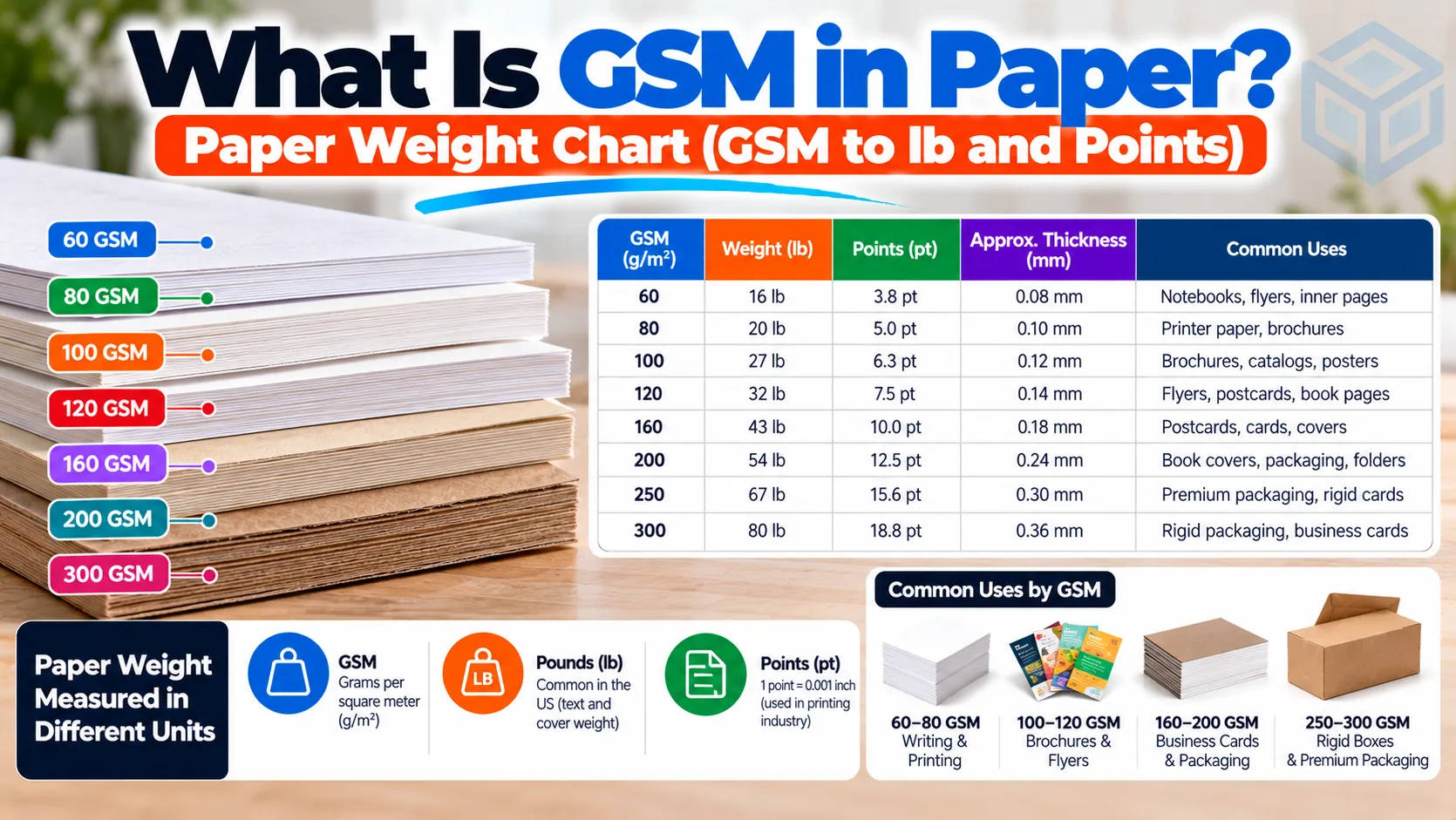
GSM stands for grams per square meter. It’s the weight of a single sheet of paper or board measuring one meter by one meter, and it’s the standard way to describe paper weight in most of the world. The higher the GSM, the heavier and usually the thicker the paper. Everyday printer paper is about 80 GSM, a postcard is around 300 GSM, and most product boxes are made from board between about 250 and 450 GSM.
If you’ve ever tried to compare a US supplier quoting “100 lb cover” with a European one quoting “270 GSM”, this guide will help. They’re nearly the same thing.
Why GSM is the easiest way to compare paper
In the US, paper is often sold by its basis weight in pounds: what 500 sheets of a particular “basis size” weigh. The problem is that different kinds of paper (bond, text, cover, index) use different basis sizes. That’s why 80 lb text paper is much lighter than 80 lb cover stock, even though the number is the same.
GSM doesn’t have that problem. One square meter is always one square meter, so 200 GSM means the same weight whether it’s a flyer, a card or a box.
GSM to pounds conversion chart
| GSM | US equivalent | Feels like | Typical use |
|---|---|---|---|
| 75 to 80 | 20 lb bond | Standard office paper | Copy paper, letters |
| 90 | 24 lb bond / 60 lb text | Slightly heavier office paper | Reports, letterheads |
| 118 | 80 lb text | Light but quality | Brochure pages, flyers |
| 148 | 100 lb text | Firm flyer | Premium flyers, posters |
| 176 | 65 lb cover | Light card | Inserts, crafts, light covers |
| 216 | 80 lb cover | Medium card | Postcards, greeting cards |
| 270 | 100 lb cover | Sturdy card | Business cards, tags |
| 298 | 110 lb cover | Heavy card | Hang tags, small cartons |
| 352 | 130 lb cover | Very heavy card | Luxury cards, retail boxes |
Quick conversions if you need them: cover weight in lb multiplied by about 2.7 gives you GSM, and text weight in lb multiplied by about 1.48 gives you GSM.
GSM vs thickness: not the same thing
GSM measures weight, not thickness. Two papers with the same GSM can feel quite different in the hand, because one may be made from bulkier fibers or have less coating. Coated, glossy paper is dense and tends to be thinner for its weight, while uncoated paper is bulkier.
For packaging, thickness is often what matters most, because it decides how stiff the box feels. In the US, board thickness is measured in points (pt), where 1 pt is one thousandth of an inch. Elsewhere it’s often given in microns (µm), where 1 pt is about 25.4 microns.
As a rough guide for coated packaging board:
| Thickness | Approximate GSM | Typical packaging use |
|---|---|---|
| 14 pt (about 355 µm) | 230 to 250 GSM | Small, light boxes and sleeves |
| 16 pt (about 405 µm) | 250 to 280 GSM | Cosmetic and soap boxes |
| 18 pt (about 455 µm) | 280 to 310 GSM | Standard retail boxes |
| 20 pt (about 510 µm) | 300 to 330 GSM | Heavier products |
| 24 pt (about 610 µm) | 350 to 390 GSM | Premium and display boxes |
These ranges vary by board grade. FBB, for example, is bulkier than SBS, so it’s thicker at the same GSM. Our guide to paperboard grades explains why.

What GSM do you need?
| Project | Recommended GSM |
|---|---|
| Copy and printer paper | 70 to 90 GSM |
| Letterheads | 90 to 120 GSM |
| Flyers and leaflets | 130 to 170 GSM |
| Brochure covers | 200 to 300 GSM |
| Postcards and invitations | 250 to 350 GSM |
| Business cards | 300 to 400 GSM |
| Hang tags | 300 to 400 GSM |
| Folding boxes (retail cartons) | 250 to 450 GSM |
| Rigid box wrapping paper | 120 to 160 GSM, wrapped around thick chipboard |
What does GSM mean for packaging?
For boxes, GSM is one part of the decision, alongside board grade, thickness and structure:
- Light products such as lip balm, tea sachets or small jewelry are fine in 250 to 300 GSM board.
- Most cosmetics, skincare, candles and soap sit well in 300 to 350 GSM.
- Heavier products, glass bottles or larger boxes need 350 GSM and up, or a move to corrugated board.
- Rigid boxes don’t follow the same scale. They use thick chipboard (often 1 to 3 mm) wrapped in a thin printed paper.
If your product is heavy or you’re shipping it directly to customers, corrugated board is usually the better choice. Corrugated isn’t usually described by GSM at all; it’s described by flute type and strength ratings. See what cardboard is made of for more.
How to check GSM yourself
If you have a sample and a kitchen scale that measures to a tenth of a gram, you can work out the GSM:
- Cut a piece of exactly 10 x 10 cm.
- Weigh it in grams.
- Multiply by 100.
A 10 x 10 cm piece weighing 3 grams is 300 GSM. Simple, and surprisingly accurate.
Common GSM mistakes
- Comparing lb weights across categories. 80 lb text and 80 lb cover are very different papers.
- Assuming higher GSM always means stiffer. Board grade and coating matter too.
- Choosing heavy board for big boxes when corrugated would be lighter, stronger and cheaper to ship.
- Forgetting folding. Very heavy coated board can crack along folds without proper scoring. Our article on die cutting explains how creasing helps.
Packaging board options at Apexio
We print boxes on 12 pt to 24 pt cardstock, SBS, kraft, corrugated and rigid stocks, so you can pick the weight that suits your product. Most brands land on 16 or 18 pt for custom cosmetic boxes and soap boxes. For more on stock thickness, see what cardstock is. Tell us your product weight and size and we’ll recommend the right board, with a free digital proof.
Frequently asked questions
GSM means grams per square meter. It tells you how much one square meter of the paper weighs, which is a reliable way to compare paper weights.
Higher GSM means heavier paper, which usually feels more premium and durable. It isn’t always better, though; flyers and inserts don’t need heavy stock, and very heavy board can be harder to fold.
Cardstock usually starts at around 170 GSM and goes up to 400 GSM or more.
Most business cards are printed on 300 to 400 GSM card.
For cover stock, divide GSM by about 2.7. For text paper, divide GSM by about 1.48. For example, 270 GSM is roughly 100 lb cover.