
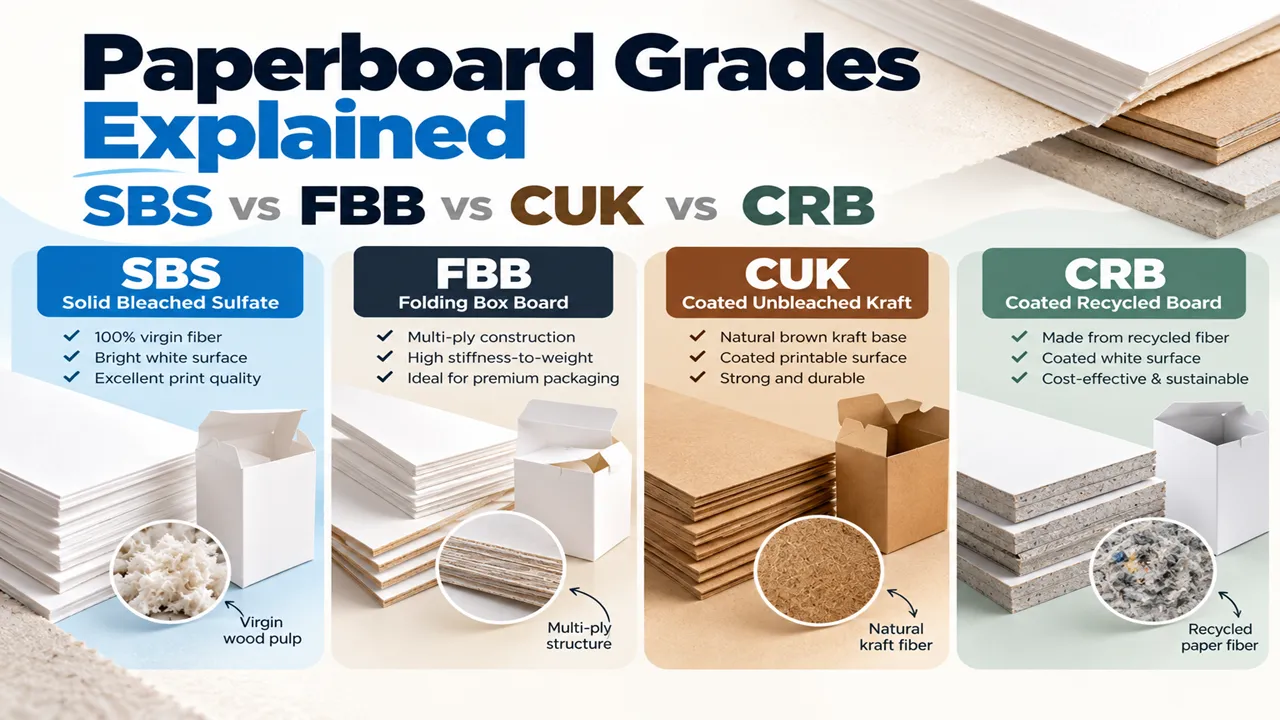
Paperboard grades describe what a board is made of and how it’s finished. The four main grades for folding cartons are SBS (solid bleached sulfate), FBB (folding boxboard), CUK (coated unbleached kraft) and CRB (coated recycled board). SBS is the bright white premium choice, FBB is a lighter, stiff alternative, CUK is the strongest, and CRB is the most economical, recycled option.
If you’ve ever asked a packaging supplier for a quote and been asked “which board grade?”, this guide is for you.
Paperboard grades at a glance
| Grade | Also called | Fiber | Color (front/back) | Strength | Print quality | Relative cost |
|---|---|---|---|---|---|---|
| SBS | Solid bleached board, C1S or C2S board | Virgin bleached chemical pulp | White/white | Good | Excellent | High |
| FBB | GC1, GC2, folding boxboard | Virgin, layered chemical and mechanical pulp | White / cream or white | Good stiffness for its weight | Very good | Medium to high |
| CUK | SUS, coated natural kraft | Virgin unbleached kraft pulp | White coated / brown | Very high | Good | Medium |
| CRB | CCNB, WLC, recycled board | Recycled fiber | White coated / grey | Moderate | Good | Low |
SBS: solid bleached sulfate
SBS is made entirely from bleached virgin wood pulp, so it’s white all the way through. It’s usually clay-coated on one side (C1S) for printing, or on both sides (C2S) when the inside of the box is printed too.
What it’s good at:
- The cleanest, brightest print surface, so colors look accurate and photos look sharp
- A smooth surface that works well with foil, spot UV, embossing and soft-touch lamination
- A clean, white inside, with no grey or brown showing at cut edges
Where you’ll see it: cosmetics and skincare, fragrance, pharmaceuticals, premium food and confectionery, and retail packaging where the box has to look perfect. It’s also a common choice for food that touches the board directly, because it’s made from virgin fiber.

FBB: folding boxboard
FBB is built in layers. The outer layers are bleached chemical pulp, and the middle layer is mechanical pulp, which is bulkier. That structure makes FBB stiffer than SBS at the same weight, so you can often use a lighter board and still get a rigid box.
The back is often a cream or light shade rather than bright white, which matters only if the inside of the box is visible. FBB is very common in Europe, where you’ll see it graded as GC1 (white back) and GC2 (cream back).
Good for: food and confectionery cartons, cosmetics, pharmaceuticals and retail products where you want good print and stiffness at a sensible cost.
CUK: coated unbleached kraft
CUK is made from unbleached virgin kraft fiber, the same long, strong fibers used for brown paper bags, with a white clay coating on the printed side. The back stays brown.
Its big advantage is strength. Long kraft fibers resist tearing and hold up well in cold and damp conditions, which is why CUK is used for beverage carriers (like the cardboard around a six-pack), frozen food cartons and heavier products.
Good for: drinks multipacks, frozen and chilled food, hardware and anything that needs a tough carton.
CRB: coated recycled board
CRB is made from recycled fiber, usually with a white coated top layer for printing and a grey or brown back. In the US it’s often called clay-coated news back (CCNB), and in Europe the equivalent is white lined chipboard (WLC, graded GD or GT).
It’s the most economical grade and has strong sustainability credentials because it’s made from recovered paper. The trade-off is slightly lower brightness, a grey inside and less strength than virgin boards.
Good for: cereal and dry food boxes (usually with an inner bag), toys, games, household goods and shoe boxes. For food that touches the board directly, recycled board usually needs a liner or barrier, so check with your supplier.
What about plain kraft board?
Uncoated kraft board has no white coating at all, so the natural brown shows on both sides. It’s popular with eco-friendly brands that want an earthy look. Print sits on the brown surface, so colors appear darker and more muted. White ink or a white underlayer can help logos pop. If you’re comparing kraft with corrugated, our guide to what cardboard is made of explains the difference.
Board thickness: points, GSM and microns
Paperboard thickness is measured in points (pt) in the US. One point is 0.001 inch. In Europe and Asia, suppliers usually describe board by weight in grams per square meter (GSM) or by thickness in microns.
| Thickness (pt) | Thickness (mm) | Typical use |
|---|---|---|
| 14 pt | 0.36 mm | Small, light products, sleeves, tags |
| 16 pt | 0.41 mm | Cosmetic and retail cartons |
| 18 pt | 0.46 mm | Standard retail boxes |
| 20 pt | 0.51 mm | Heavier products, larger cartons |
| 24 pt | 0.61 mm | Premium or heavy items, display boxes |
GSM and points don’t convert exactly, because two boards with the same weight can have different thickness (FBB is bulkier than SBS, for example). As a rough guide, 18 pt SBS is roughly 300 GSM. When in doubt, ask for a physical sample.
Rigid boxes are a different category. They’re made from thick chipboard (greyboard), usually 1 to 3 mm, wrapped in printed paper. You can see this on our custom rigid boxes.
How to choose the right paperboard grade
Ask yourself these questions:
- Does the box need to look premium? Choose SBS or FBB.
- Will the inside of the box be seen or printed? SBS (C2S) gives a white inside.
- Is the product heavy, cold or wet? CUK is the strongest choice.
- Is cost the main driver, or a recycled story? CRB is the most economical.
- Do you want a natural, earthy look? Go with uncoated kraft.
- Will it touch food directly? Virgin board like SBS is the usual choice, or use a liner.
For most beauty, wellness and retail brands, 16 to 18 pt SBS is the default, and it’s what we recommend for custom cosmetic boxes. Our quote form also lets you pick 12 pt to 24 pt cardstock, kraft, corrugated and rigid stock, and we’re happy to send material samples.
Finishes look different on each grade too. Foil and embossing are sharpest on smooth SBS. Read embossing vs debossing for more.
Frequently asked questions
There’s no single best. SBS gives the best print and a premium look, CUK is the strongest, FBB balances stiffness and cost, and CRB is the most economical.
SBS (solid bleached sulfate) is paperboard made from bleached virgin wood pulp. It’s white throughout and clay-coated for high-quality printing.
SBS is made from bleached chemical pulp throughout. FBB has a layered structure with a bulkier mechanical pulp core, so it’s stiffer at the same weight but often has a cream-colored back.
Yes. CRB is made from recycled fiber and can be recycled again with ordinary paper and cardboard.
C1S means coated on one side, and C2S means coated on two sides. Coating creates a smooth surface for printing.