
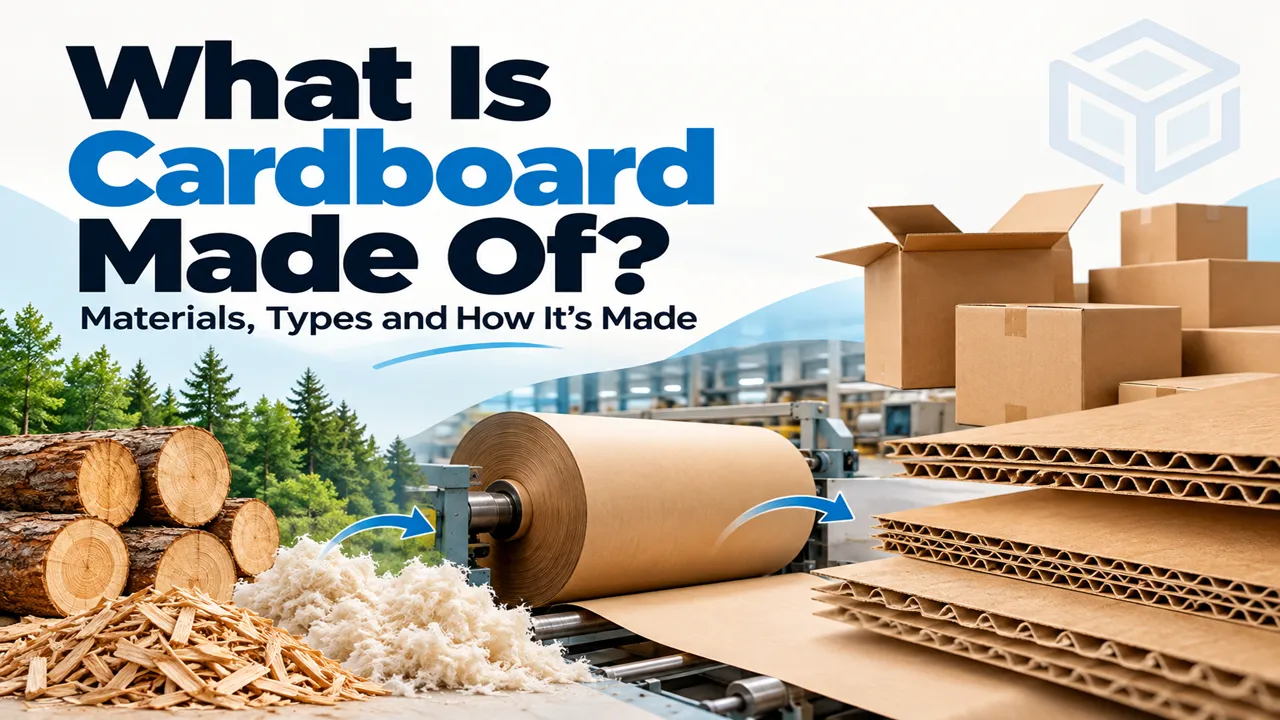
Cardboard is made from paper fibers, which come from wood pulp and recycled paper. The fibers are mixed with water, pressed and dried into thick sheets. For corrugated cardboard, a wavy middle layer (the fluting) is glued between two flat sheets (the liners) using a starch-based glue, usually made from corn or wheat starch. That’s it: wood fiber, water, starch and a lot of heat and pressure.
The word “cardboard” is used loosely, though. In packaging, it can mean two quite different materials, and knowing which is which helps when you’re choosing boxes.
Two kinds of “cardboard”
| Paperboard | Corrugated cardboard | |
|---|---|---|
| Structure | One thick, solid layer | Fluted layer between two liners |
| Thickness | About 0.3 to 0.7 mm | About 1 to 7 mm or more |
| Feel | Smooth and stiff, like a cereal box | Light but rigid, with visible ridges at the edge |
| Typical uses | Cosmetic boxes, food cartons, retail packaging | Shipping boxes, mailer boxes, displays |
| Printing | Very sharp, photo-quality | Good, especially on white or E-flute board |
When someone says cardboard box, they usually mean corrugated. When they say a cardboard cereal box, they mean paperboard. Both start from the same raw material.
The raw materials
Wood pulp
Most new (virgin) fiber comes from trees. Softwoods like pine and spruce have long fibers that make board strong. Hardwoods have shorter fibers that help create a smooth printing surface. Much of the wood used comes from managed forests and sawmill leftovers like wood chips, and certified sources such as FSC let brands confirm where the fiber came from.
Recycled paper
A large share of cardboard is made from recovered paper and old boxes. Recycled fibers are pulped, cleaned, and screened, then made into new board. Each time paper is recycled, the fibers get a little shorter, so mills often blend recycled fiber with some virgin fiber to keep the board strong.
Starch and additives
The glue that holds corrugated board together is usually starch-based. Mills can also add sizing agents to control how the board absorbs water and ink, and coatings or waxes for moisture resistance when a box will be used in cold or wet conditions.
How cardboard is made, step by step
1. Pulping
Wood chips are cooked to separate the cellulose fibers from lignin, the natural glue that holds wood together. The most common method is the kraft process, which uses a chemical solution under heat and pressure. Kraft is the German and Swedish word for strength, and kraft pulp produces strong, brown fibers. Recycled paper is simply mixed with water and broken back down into pulp.
2. Forming the sheet
The watery pulp is spread onto a moving wire mesh on a paper machine. Water drains away and the fibers bond together into a continuous wet sheet. Paperboard is often built up from several layers of pulp to reach the right thickness.
3. Pressing and drying
The sheet passes through heavy rollers that squeeze out water, then over large steam-heated drying cylinders. For paperboard, a clay coating may be added at this stage to create a smooth white surface for printing.
4. Corrugating
To make corrugated cardboard, rolls of paper go into a machine called a corrugator. One paper (the medium) is softened with steam and pressed between ridged rollers to form the flutes. Starch glue is applied to the tips of the flutes, and the liners are pressed on, one on each side. Heat sets the glue almost instantly.
5. Cutting and converting
The finished board is cut into sheets, then printed, die cut, creased and folded into boxes. That’s the stage where a sheet of board becomes your custom mailer box.

Corrugated flute types
The size of the flutes decides how thick, strong and printable corrugated board is.
| Flute | Approximate thickness | Characteristics | Common uses |
|---|---|---|---|
| A flute | 4.8 mm (3/16 in) | Thickest, best cushioning | Fragile items, packing |
| C flute | 4 mm (5/32 in) | Good stacking strength | Standard shipping cartons |
| B flute | 3.2 mm (1/8 in) | Good crush resistance | Shipping boxes, displays |
| E flute | 1.6 mm (1/16 in) | Thin, smooth print surface | Mailer boxes, retail boxes |
| F flute | 0.8 mm (1/32 in) | Very thin and light | Small retail boxes, food boxes |
Boards are also made in different wall builds:
- Single wall: one layer of flutes between two liners. The most common.
- Double wall: two layers of flutes (often B and C together, called BC flute). For heavier products.
- Triple wall: three layers of flutes. Used for very heavy items and industrial shipping.
How cardboard strength is measured
Two tests show up on box specifications:
- Edge Crush Test (ECT) measures how much force the board can take on its edge before it crushes. It’s a good guide to how well boxes stack. 32 ECT is a common rating for single-wall shipping boxes.
- Burst test (Mullen) measures how much pressure the board’s surface can take before it bursts. It’s useful for boxes that get rough handling.
You’ll often see these printed in a small circular stamp on the bottom of a shipping box, called the box maker’s certificate.
Brown vs. white cardboard
Brown cardboard is made from unbleached kraft or recycled fibers, so it keeps the natural wood color. White cardboard uses bleached fibers, or a white top liner over a brown core. White board shows printed colors more brightly; brown kraft gives a natural, eco-friendly look and hides scuffs better. For more on the different board grades, see our guide to paperboard grades: SBS, FBB, CUK and CRB.
Is cardboard recyclable and biodegradable?
Yes, on both counts. Cardboard is one of the most recycled packaging materials in the US, and recovered boxes go straight back into making new board. It’s also biodegradable and compostable when shredded, as long as it isn’t heavily coated with plastic.
A few things make recycling harder: plastic laminations, heavy wax coatings and food contamination. Many recycling programs now accept pizza boxes with light grease, but check your local rules. Removing excess tape and flattening boxes helps too.
Choosing cardboard for your packaging
- For shipping products directly to customers, E-flute or B-flute corrugated mailers balance strength and print quality.
- For retail shelves, paperboard boxes give the sharpest print.
- For heavy or fragile items, use double-wall corrugated with inserts.
- For a natural look, brown kraft corrugated or kraft paperboard.
Not sure what you need? Our custom corrugated mailer boxes come in brown kraft and white, in E-flute and B-flute, and we’ll recommend the right board for your product’s size and weight. If you’re working out the box size too, read our guide on how to measure a box for shipping.
Frequently asked questions
Cardboard is made of paper fibers from wood pulp and recycled paper. Corrugated cardboard adds a fluted middle layer glued between two flat liners with starch-based glue.
Partly. Virgin cardboard fiber comes from trees, mostly from managed forests and sawmill leftovers. A large share of cardboard is also made from recycled paper and old boxes.
Cardboard is an everyday word that can mean any heavy paper-based board. Corrugated board specifically has a wavy fluted layer between two liners, which makes it strong and light.
Corrugated cardboard is usually glued with a starch-based adhesive made from corn, wheat, or potato starch.
Brown cardboard is made from unbleached kraft or recycled fibers, which keep the natural color of wood. White cardboard is bleached or has a white top layer.