
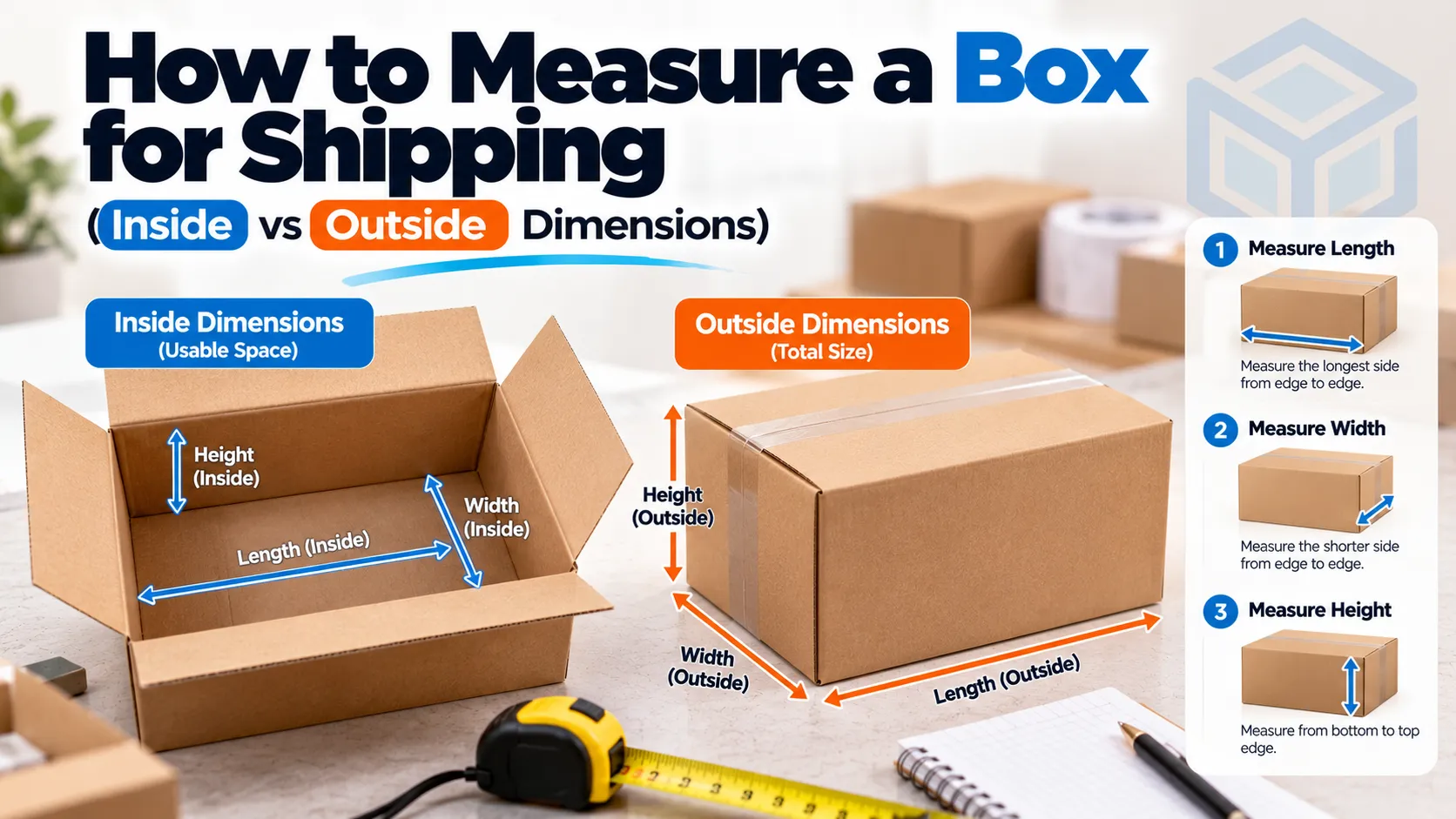
To measure a box for shipping, measure the outside of the sealed box with a tape measure: length (the longest side), width (the next longest side) and height (the remaining side). Round any fractions up to the next whole inch and write it as L x W x H. Carriers use these outside dimensions, not the inside ones, to work out your price.
If you’re measuring a box to fit a product, you need the inside dimensions instead. That’s the most common mix-up, and it’s covered below.
What you’ll need
- A rigid tape measure (a soft sewing tape bends and gives slightly short readings)
- The box, packed and taped shut exactly as it will ship
- A pen, or your phone’s notes app
Measure the box after it’s packed. A box stuffed with a few extra items can bulge by half an inch, and carriers measure the bulge.
Step-by-step: measuring a box for shipping
- Put the box on a flat surface with the largest side facing up.
- Measure the length: the longest side of the box, edge to edge.
- Measure the width: the shorter side on the same face, at a right angle to the length.
- Measure the height: from the surface the box is sitting on to the top of the box.
- If a side bulges, measure across the widest point, not the edge.
- Round each measurement up to the next whole inch. A side of 11 1/4 inches becomes 12.
- Write the result as L x W x H, for example 12 x 10 x 6 in.
For shipping, the length is always the longest side, whichever way the box is sitting. That’s slightly different from how packaging suppliers describe boxes (where the opening decides which side is the length), and we explain that in our guide to box dimensions and L x W x H.
Inside vs outside dimensions
| Inside dimensions | Outside dimensions | |
|---|---|---|
| Used for | Making sure the product fits | Calculating shipping cost |
| Measured | Inner wall to inner wall | Outer edge to outer edge |
| Who asks for it | Packaging suppliers | UPS, FedEx, USPS, DHL |
| Difference | Smaller | Bigger by roughly two board thicknesses |
When you order boxes, give the inside size. When you book a shipment, give the outside size. A double-wall carton can easily be half an inch bigger on the outside than the inside, so mixing these up can mean a box that won’t fit the product or a quote that’s too low.
What is length plus girth?
Carriers use length plus girth to check whether a parcel is too big for their standard network.
Girth is the distance around the box at its thickest part, measured at a right angle to the length. For a rectangular box, girth = 2 x width + 2 x height.
Length plus girth = length + (2 x width) + (2 x height).
Example: a box measuring 20 x 12 x 10 inches has a girth of 2 x 12 + 2 x 10 = 44 inches. Add the length and you get 64 inches of length plus girth.
At the time of writing, UPS and FedEx accept packages up to 108 inches in length and 165 inches in length plus girth, and USPS accepts most parcels up to 108 inches in length plus girth (130 inches for USPS Ground Advantage). Go over those numbers and you’ll pay oversize fees or need freight. Carriers update their limits, so check before shipping something large.
How dimensional (DIM) weight works
Carriers charge for space as well as weight. Once you have the outside dimensions, the DIM weight is:
L x W x H divided by the carrier’s divisor.
UPS and FedEx commonly use a divisor of 139 for inches and pounds, and USPS uses 166 for larger parcels. You’re charged for whichever is higher: the actual weight or the DIM weight.
| Box (outside, inches) | Volume (cubic inches) | DIM weight at 139 | Billed if actual weight is 5 lb |
|---|---|---|---|
| 10 x 8 x 6 | 480 | 3.5 lb, rounds to 4 lb | 5 lb (actual is higher) |
| 14 x 12 x 8 | 1,344 | 9.7 lb, rounds to 10 lb | 10 lb (DIM is higher) |
| 18 x 14 x 12 | 3,024 | 21.8 lb, rounds to 22 lb | 22 lb (DIM is higher) |
The middle row is where a lot of small businesses lose money without realizing it. A light product in a box that’s a bit too big gets billed by size.
How to measure irregular packages
Not everything ships in a neat rectangle.
Poly mailers and padded envelopes
Lay the mailer flat with the product inside and measure the length and width. For height, measure the thickest point. Carriers treat soft packs as rectangles using these maximum measurements.
Tubes and cylinders
Length is the length of the tube. Width and height are both the diameter. A 30-inch tube with a 4-inch diameter is measured as 30 x 4 x 4.
Odd shapes
Imagine the smallest rectangular box the item would fit into, and measure that. Carriers will do the same.
Tips to reduce your shipping costs
- Use the smallest box that protects the product. An inch less on each side can cut DIM weight a lot.
- Use custom-sized boxes for products you ship often. Off-the-shelf boxes rarely fit well, and the extra air costs you on every order.
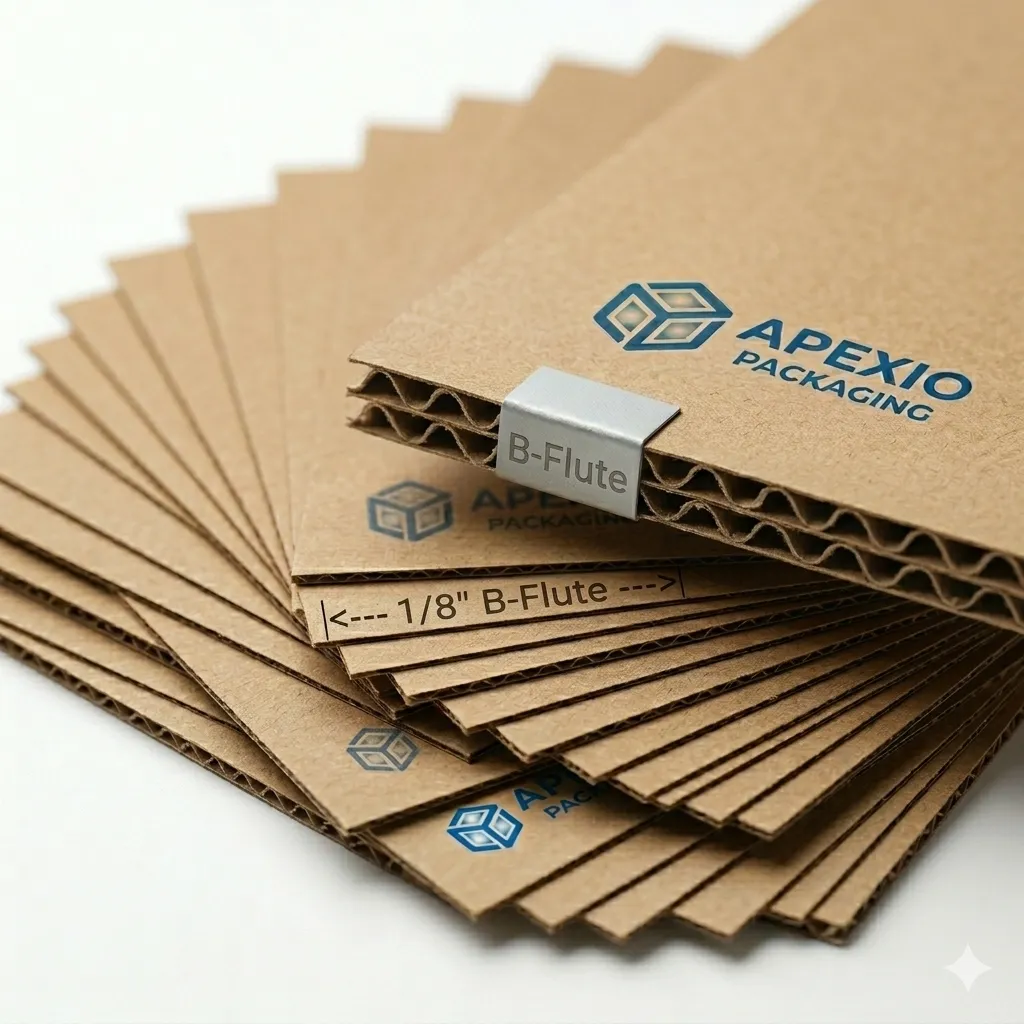
- Choose lighter materials where you can. E-flute corrugated is thinner than B-flute and works well for many retail products.
- Pack firmly so the box doesn’t bulge.
- Weigh and measure a few sample shipments yourself and compare them with what the carrier billed. It’s an easy way to catch problems early.
If you’re shipping the same product regularly, a right-sized custom corrugated mailer box usually pays for itself quickly in lower DIM weight. Tell us the product size and we’ll suggest the smallest box that still protects it. You can also browse our full range of custom mailer boxes.
Frequently asked questions
The outside. Carriers calculate price and size limits from the outside dimensions of the packed, sealed box.
The longest side of the box is always the length for shipping purposes. Width is the next longest, and height is the shortest.
Round up to the next whole inch. Carriers work in whole inches, and rounding down can lead to adjustments and extra charges after the parcel is measured.
For a rectangular box, girth is 2 x width plus 2 x height. Add the length to get length plus girth.
Dimensional weight is a billing weight based on box size. It’s the box volume (L x W x H) divided by the carrier’s divisor, such as 139 or 166. You pay whichever is higher, DIM weight or actual weight.