
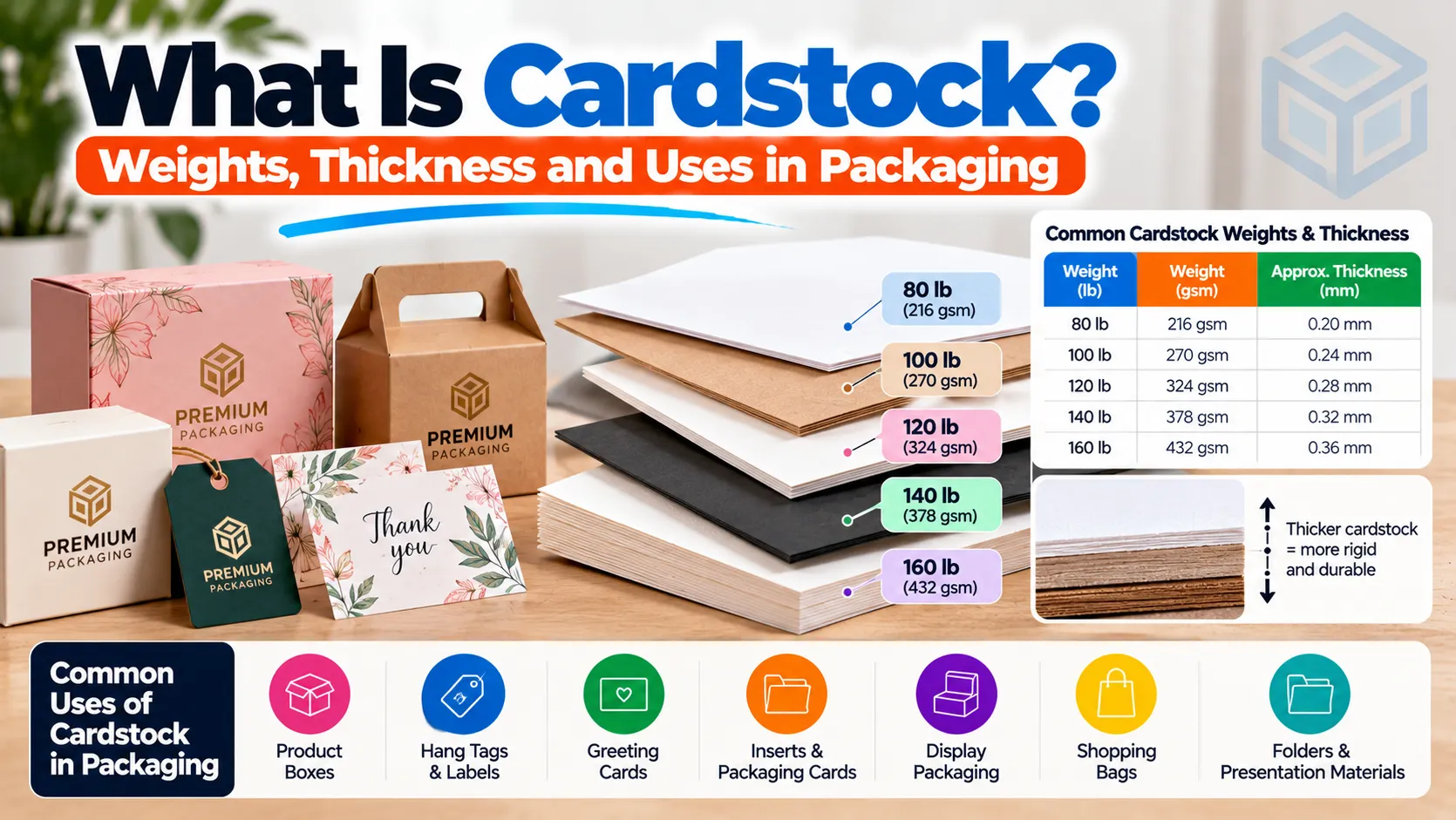
Cardstock is a thick, stiff paper that sits between regular printer paper and paperboard. It’s heavier and more durable than standard paper, usually starting around 65 lb cover (about 176 GSM), and it’s used for business cards, greeting cards, invitations, tags and lightweight packaging. In the packaging world, the heavier grades from about 12 pt to 24 pt are what most folding boxes are made from.
The confusing part is how cardstock is measured. You’ll see it described in pounds, in GSM and in points, sometimes all on the same website. Let’s sort that out.
Cardstock vs paper vs cardboard
| Printer paper | Cardstock | Corrugated cardboard | |
|---|---|---|---|
| Typical weight | 75 to 120 GSM | 170 to 400+ GSM | Much heavier, multi-layer |
| Structure | Thin single sheet | Thick single sheet | Fluted layer between two liners |
| Feel | Flexible, floppy | Stiff, holds its shape | Rigid with ridged edges |
| Common uses | Documents, flyers | Cards, tags, cartons | Shipping and mailer boxes |
Cardstock is a single solid sheet. That’s what separates it from corrugated cardboard, which has a wavy fluted layer inside. If you want the full story on corrugated board, read what cardboard is made of.
How cardstock weight is measured
Pounds (lb)
In the US, paper is weighed in pounds based on 500 sheets of a standard “basis” size. The catch is that different paper types use different basis sizes, so 80 lb text paper and 80 lb cover stock are very different. Cardstock is usually listed as cover weight (written as lb cover or #C).
GSM (grams per square meter)
GSM is the weight of one square meter of the paper. It’s used almost everywhere outside the US and it’s the easiest to compare, because it doesn’t depend on a basis size. Higher GSM means heavier stock.
Points (pt)
Points measure thickness, not weight. One point is one thousandth of an inch (0.001 in). Packaging suppliers in the US usually quote board in points, because thickness is what decides how stiff a box feels.
Cardstock weight chart
| Cover weight | Approximate GSM | Approximate thickness | Typical use |
|---|---|---|---|
| 65 lb cover | 176 GSM | 9 pt | Crafts, light cards, inserts |
| 80 lb cover | 216 GSM | 10 to 11 pt | Postcards, greeting cards, invitations |
| 100 lb cover | 270 GSM | 12 to 13 pt | Business cards, tags, sturdy cards |
| 110 lb cover | 298 GSM | 14 pt | Hang tags, premium cards, small cartons |
| 130 lb cover | 352 GSM | 16 to 18 pt | Luxury cards, retail boxes |
To convert cover weight to GSM, multiply by about 2.7. The thickness column is approximate, because two papers with the same weight can differ in thickness depending on the fibers and coating.

Cardstock thickness for packaging boxes
Once you get into product packaging, people stop talking about cover weight and use points instead. These are the standard thicknesses we print boxes on:
| Thickness | How it feels | Best for |
|---|---|---|
| 12 pt | Light and flexible | Sleeves, small inserts, very light items |
| 14 pt | Light but sturdy | Lip balm, small cosmetics, tags |
| 16 pt | Solid, the everyday standard | Cosmetic boxes, soap boxes, retail cartons |
| 18 pt | Firm, with a premium feel | Skincare, candles, food boxes |
| 20 to 22 pt | Stiff | Heavier products, larger boxes |
| 24 pt | Very stiff | Premium and heavy items, display boxes |
For most retail products under a pound, 16 or 18 pt is the sweet spot. Go thicker for heavier products, larger boxes, or when you want the box to feel more substantial in the hand. For more detail on the board itself, see our guide to paperboard grades like SBS and FBB.
Types of cardstock
- Uncoated cardstock has a natural, slightly textured feel. It’s easy to write on, which suits tags and invitations.
- Coated cardstock has a smooth gloss, matte or silk coating that makes printed colors sharper and more vivid.
- SBS (solid bleached sulfate) is bright white all the way through and the most common choice for printed retail boxes.
- Kraft cardstock is unbleached and brown, popular with eco-friendly and handmade brands.
- Textured cardstock, like linen or felt finishes, adds a tactile feel for invitations and luxury packaging.
- Metallic and pearlescent cardstock has a shimmer built into the paper.
What is cardstock used for?
- Business cards and greeting cards
- Wedding invitations and event stationery
- Hang tags and product labels
- Postcards and menus
- Scrapbooking and crafts
- Folding cartons for cosmetics, soap, candles and food
- Sleeves, belly bands and packaging inserts
Can you print on cardstock at home?
Usually yes, up to a point. Many home inkjet and laser printers handle lighter cardstock (65 to 80 lb cover) with no trouble. Heavier stock can jam or smear, so check your printer’s maximum paper weight and use the rear or manual feed tray if it has one. For anything thicker than about 110 lb cover, or for boxes, you’ll need a commercial printer.
Printing tips for cardstock packaging
- Score before folding. Thick cardstock cracks along a fold if it isn’t creased first. Professional boxes are always scored during die cutting.
- Watch dark colors on folds. Heavy ink coverage can crack and show white at the fold line. A lamination helps prevent this.
- Pick the right coating. Matte and soft-touch laminations feel premium and resist scuffs; gloss makes colors pop.
- Add finishes after the right stock is chosen. Foil, spot UV and embossing or debossing all look sharpest on smooth, coated cardstock.
Custom cardstock boxes
We print custom boxes on 12 pt to 24 pt cardstock, along with kraft, corrugated and rigid stocks. Popular options include cardstock candle boxes, custom soap boxes and custom cosmetic boxes. Not sure what thickness you need? Tell us what your product weighs and its size, and we’ll recommend a stock and send a free digital proof.
Frequently asked questions
Cardstock is heavy, thick paper that’s stiffer than regular printer paper. It’s used for cards, invitations, tags, crafts and folding boxes.
No. Cardstock is a single thick sheet of paper. Corrugated cardboard has a fluted middle layer between two liners and is much thicker and stronger.
Cardstock usually starts at about 65 lb cover (176 GSM) and goes up to 130 lb cover (352 GSM) or more. Packaging board is usually described by thickness, from 12 pt to 24 pt.
16 pt and 18 pt are the most popular for retail boxes. Use 14 pt for very small, light items and 20 to 24 pt for heavier products.
Yes. Uncoated and lightly coated cardstock goes in regular paper recycling. Heavy plastic laminations and glitter can make it harder to recycle.