

A tuck box (or tuck end box) is a folding carton that closes by tucking a flap into the opening, instead of using glue or tape. It’s made from a single printed sheet of paperboard, glued along one side seam and shipped flat, then folded into shape when you pack it. Most cosmetic, supplement, soap and small retail boxes you see on a shelf are tuck boxes.
They’re popular because they’re cheap to make, quick to pack and easy for customers to open and close. The main question is which tuck style suits your product.
How a tuck box works
Each end of a tuck box has three parts:
- A tuck flap, the main closure that folds over the opening and slides inside the box
- Two dust flaps, small side flaps that fold in first to keep dust out and give the closure some grip
- A friction or slit lock, small cuts or curved shoulders on the tuck flap that hold it in place once it’s tucked
Because the box is glued only along its side seam, it ships flat in a stack. That saves a lot of storage space compared with rigid boxes.
The main tuck box styles
| Style | How the ends close | Strengths | Best for |
|---|---|---|---|
| Reverse tuck end (RTE) | Top and bottom flaps tuck from opposite sides | Most economical, efficient on the press | Cosmetics, supplements, general retail |
| Straight tuck end (STE) | Top and bottom flaps tuck from the same side | Clean, uninterrupted front panel | Window boxes, premium retail, display |
| Tuck top auto bottom | Top tucks; bottom pops into place and locks | Fast to assemble, holds more weight | Bottles, jars, heavier products |
| Tuck top snap lock bottom | Top tucks; bottom folds into a 1-2-3 lock | Stronger base, lower cost than auto bottom | Candles, food jars, mid-weight items |
Reverse tuck end
In a reverse tuck end box, the top flap is attached to the back panel and the bottom flap to the front panel, so they tuck in opposite directions. This layout fits more boxes on each printed sheet, which keeps the cost down. It’s the default choice for most small retail products.
Straight tuck end
In a straight tuck end box, both flaps are attached to the same panel. That keeps the front of the box completely clean, with no flap edge showing. It’s a good choice when the front panel has a window, or when the box is displayed and you want an uninterrupted design. It usually costs slightly more because the layout uses more board.
Tuck top auto bottom
The bottom of an auto bottom box is pre-glued so it snaps into place as soon as you open the box from flat. It’s much faster to pack and the base is strong enough for glass bottles and heavier items. If you’re packing hundreds of boxes, the time saved can be significant.
Tuck top snap lock bottom
Also called a 1-2-3 bottom, this base folds in by hand in three steps and locks together. It’s stronger than a tuck bottom and cheaper than an auto bottom, but slower to assemble.
What material are tuck boxes made of?
Most tuck boxes are made from paperboard between 14 pt and 24 pt. SBS (bright white board) is the most common because it prints sharply, but kraft board is popular for natural and eco-friendly products.
| Product weight | Suggested board |
|---|---|
| Very light (lip balm, tea sachets) | 14 pt |
| Light to medium (cosmetics, soap, supplements) | 16 to 18 pt |
| Heavier (glass jars, candles) | 18 to 24 pt, or an auto bottom style |
Read more about board options in our guides to what cardstock is and paperboard grades.
How to measure a tuck box
Tuck boxes are measured as length x width x depth, where length and width describe the opening at the end of the box and depth is the long dimension from one end to the other. So a serum carton listed as 2 x 2 x 5 inches has a 2 x 2 inch opening and is 5 inches tall. Our guide to box dimensions explains this in more detail.
Always quote the inside dimensions of the box, measured from your product, and add a little clearance (about 1/16 to 1/8 inch) so the product slides in easily.
Add-ons that work well on tuck boxes
- Windows: a die-cut window with clear film lets the product show through
- Inserts: a cardboard insert stops bottles moving around
- Hang tabs: for products displayed on pegs
- Finishes: matte or gloss lamination, foil, spot UV and embossing
- Inside printing: a message or pattern printed inside the box
The shapes and closures of a tuck box are created by die cutting, so most of these add-ons don’t add much cost once the die is made.
Tuck boxes vs other box styles
| Tuck end box | Mailer box | Rigid box | |
|---|---|---|---|
| Material | Paperboard | Corrugated | Chipboard wrapped in paper |
| Ships flat | Yes | Yes | No (unless collapsible) |
| Strength | Light to medium | Strong, good for shipping | Very strong |
| Cost | Lowest | Medium | Highest |
| Best for | Retail shelves | E-commerce shipping | Luxury and gifts |
If your product ships directly to customers, a tuck box often goes inside a mailer or shipping carton. For premium products, see our guide to types of rigid boxes.
Custom tuck boxes from Apexio
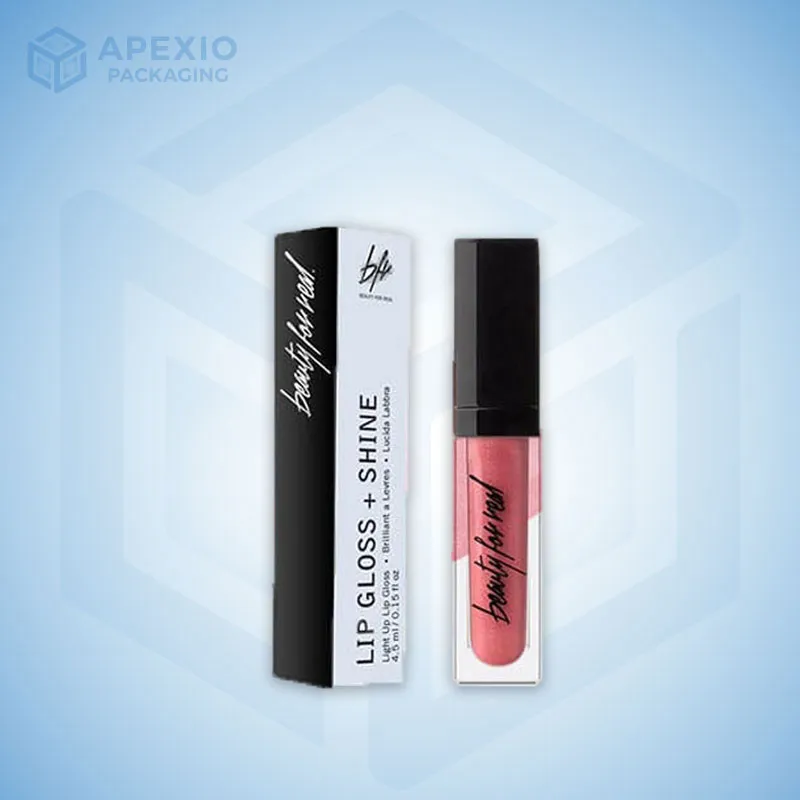
We make tuck end boxes in all of the styles above, in 12 to 24 pt cardstock and kraft board. Popular uses include custom cosmetic boxes, lip gloss boxes and foundation boxes. Send us your product size and we’ll suggest the right tuck style, with a free dieline and digital proof.
Frequently asked questions
A tuck end box is a folding carton that closes by tucking a flap into each end. It’s made from one piece of paperboard and glued along the side.
In a reverse tuck end box, the top and bottom flaps tuck in from opposite sides. In a straight tuck end box, both flaps tuck in from the same side, which keeps the front panel clean.
A tuck top auto bottom box is the strongest of the common tuck styles, because its pre-glued base locks into place and supports heavier products.
They’re designed for retail display rather than shipping. For e-commerce, put tuck boxes inside a corrugated mailer or shipping box.
Dust flaps are the small side flaps at each end of a tuck box. They fold in first, keep dust out and help hold the tuck flap closed.