
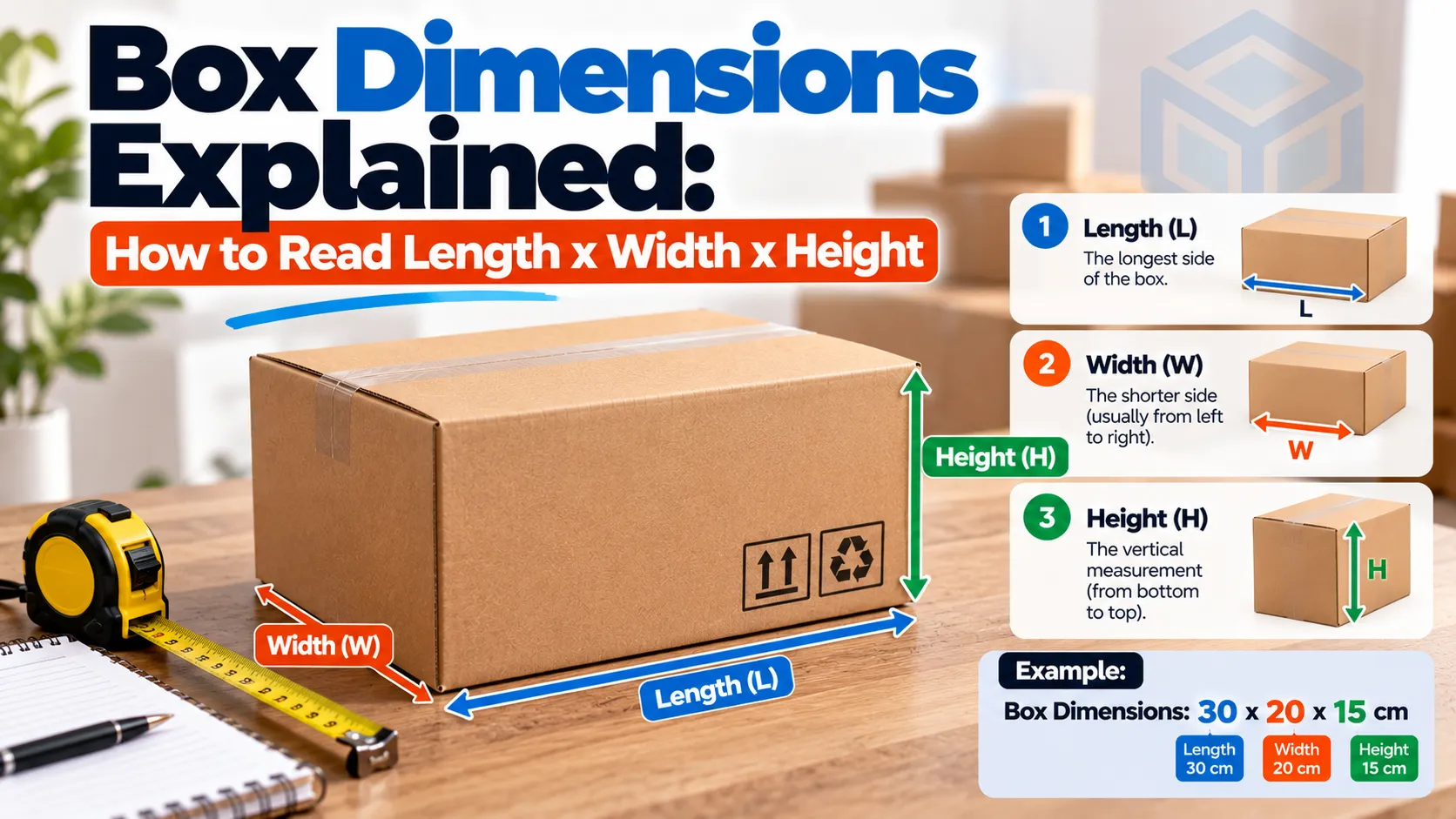
Box dimensions are written in the order Length x Width x Height (L x W x H). Length is the longer side of the opening, width is the shorter side of the opening, and height (also called depth) is how tall the box is from the bottom to the opening. So a box listed as 12 x 8 x 4 inches has a 12 x 8 inch opening and is 4 inches deep.
It sounds simple, and it mostly is. The trouble starts when a supplier, a carrier and a product listing each use the numbers slightly differently. Here’s how to read them properly, and how to give the right sizes when you order.
What L, W and H mean on a box
Picture a box sitting on a table with its opening facing up.
- Length (L) is the longest side of the opening, measured left to right.
- Width (W) is the shorter side of the opening, measured front to back.
- Height (H) is the vertical distance from the bottom panel to the top edge of the opening. In the packaging industry this is often called depth (D).
That’s why you’ll see box sizes written as L x W x H on one site and L x W x D on another. They mean the same thing.
| Letter | Name | Where it’s measured |
|---|---|---|
| L | Length | Longer side of the opening |
| W | Width | Shorter side of the opening |
| H or D | Height or depth | Bottom to top, at a right angle to the opening |
Why the order of dimensions matters
Two boxes can have the same three numbers and still be completely different boxes. A 12 x 8 x 4 box is a flat tray-style box with a big opening, the sort used for shirts or a set of products laid side by side. A 12 x 4 x 8 box has a narrow 12 x 4 opening and stands 8 inches tall, more like a box for a bottle set.
That difference changes how the product goes in, how it sits on a shelf and which panel your logo prints on. So when you order, always give the numbers in the right order, and if your box has a specific opening (a tuck end, a lid, a sleeve), tell your supplier which face opens.
Box dimension conventions by box style
The rule of “opening first” holds for most styles, but it’s worth knowing how it applies to the common ones.
Mailer boxes
Mailer boxes open from the top like a lid, so the length and width are the footprint of the box and the depth is how tall it is. A 10 x 8 x 4 mailer is 10 inches long, 8 inches wide and 4 inches tall.
Tuck end boxes
Folding cartons like cosmetic boxes open at the ends, not the top. Here, L and W describe the opening at the end of the box, and D is the long dimension running from one end to the other. A lipstick carton might be 1 x 1 x 3.5 inches, meaning a 1 x 1 inch opening and 3.5 inches tall.
Shipping cartons (RSC)
Standard corrugated shipping boxes open from the top with four flaps, so they follow the same rule as mailers: opening first, depth last.
Inside vs outside dimensions
Every box has two sets of dimensions, because the board has thickness.
Inside dimensions are the usable space. This is what you need when you’re fitting a product. Packaging manufacturers, including us, quote custom boxes by inside dimensions so your product fits.
Outside dimensions are what the carrier measures. Shipping rates and dimensional weight are calculated from these.
The gap between them depends on the material. Thin paperboard adds very little, while a double-wall corrugated box can be about half an inch bigger on each side.
| Material | Approximate thickness | Roughly how much bigger outside |
|---|---|---|
| 18 pt paperboard | 0.018 in (0.46 mm) | Barely noticeable |
| E-flute corrugated | about 1/16 in (1.6 mm) | About 1/8 in per dimension |
| B-flute corrugated | about 1/8 in (3 mm) | About 1/4 in per dimension |
| Double-wall (BC flute) | about 1/4 in (6.5 mm) | About 1/2 in per dimension |
These are working estimates. The exact numbers depend on the board and the box style.
Standard box sizes in inches
These are common stock shipping box sizes, written as length x width x height in inches. They are a useful starting point before you order a custom size.
| Box size (in) | Type | Often used for |
|---|---|---|
| 6 x 6 x 6 | Small cube | Candles, mugs, small gifts |
| 8 x 6 x 4 | Small rectangle | Cosmetics, phone accessories, books |
| 8 x 8 x 8 | Medium cube | Jars, small kitchen items |
| 10 x 8 x 6 | Medium rectangle | Clothing, shoes for kids, gift sets |
| 12 x 9 x 3 | Flat mailer | Apparel, documents, flat products |
| 12 x 12 x 12 | Large cube | Home goods, bundled orders |
| 14 x 10 x 4 | Flat medium | Shoes, folded clothing, subscription boxes |
| 16 x 12 x 8 | Large rectangle | Small appliances, multi-item orders |
| 18 x 18 x 18 | Extra large cube | Bedding, bulky light items |
| 24 x 18 x 12 | Moving size | Household moves, bulk shipping |
How to pick the right box size for a product
Start with the product itself, not with a box size you’ve seen elsewhere.
- Measure the product at its longest, widest and tallest points, including anything that sticks out like a pump or cap.
- Add room for any insert, tissue or protective packaging.
- Add a small clearance, usually 1/8 to 1/4 inch on each dimension for a snug retail box, more if the item needs cushioning for shipping.
- Write it down in L x W x H order, with the opening clearly defined.
If you’re shipping, our step-by-step guide on how to measure a box for shipping goes through the carrier side of things in more detail.
Common mistakes when reading box sizes
- Mixing up depth and width. If a listing doesn’t say which face opens, ask.
- Ordering by outside dimensions when you meant inside, and ending up with a box that’s too tight.
- Rounding down. A product that measures 6.2 inches won’t go into a 6-inch box.
- Forgetting the insert. A foam or cardboard insert can take half an inch or more of space.
- Mixing units. Make sure everyone is talking inches or millimetres. 1 inch is 25.4 mm.
Box dimensions and shipping costs
Carriers don’t just charge by weight. They also look at the space your parcel takes up, called dimensional (DIM) weight. It’s calculated by multiplying length, width and height, then dividing by a carrier-set number. UPS and FedEx commonly use 139 for inch-and-pound calculations, and USPS uses 166 for larger parcels. You pay for whichever is higher, the real weight or the DIM weight.
Here’s a quick example. A 16 x 12 x 10 inch box has a volume of 1,920 cubic inches. Divided by 139, that’s about 13.8, so it would be billed as 14 lbs even if the product inside weighs 4 lbs. Cut that box down to 14 x 10 x 8 and the DIM weight drops to about 8 lbs. Right-sized boxes save real money. Divisors do change, so check your carrier’s current rules.
Getting custom boxes made to the right size
If you’re ordering printed packaging, you don’t have to pick from standard sizes. We make custom mailer boxes and corrugated mailer boxes to whatever inside dimensions your product needs. Send us the product measurements and we’ll work out the box size, then show you a free digital proof with the dieline before anything is printed.
Frequently asked questions
Length x Width x Height (or Depth). Length and width describe the opening, and height or depth is the distance from the bottom to the opening.
Yes. Packaging suppliers usually say depth, while shipping carriers and retailers often say height. Both mean the vertical dimension.
The longer side of the opening. For a top-opening box, that’s the longer side of the top. For an end-opening carton, the length and width describe the end panel.
It depends who’s quoting. Packaging manufacturers usually quote inside dimensions so the product fits. Carriers measure outside dimensions to calculate shipping.
Write them as three numbers with the unit, in L x W x H order, for example 10 x 8 x 4 in or 254 x 203 x 102 mm.