

A standard men’s shoe box measures about 13 x 7.5 x 4.5 inches (33 x 19 x 11 cm), and a standard women’s shoe box is about 11 x 7 x 4 inches (28 x 18 x 10 cm). Sneaker boxes run bigger, often around 14 x 10 x 5 inches, while kids’ boxes start at about 8 x 5 x 3 inches and tall boot boxes can reach 20 x 14 x 5 inches or more.
There’s no single official shoe box size. Every brand designs its own, so the numbers below are typical ranges. They’re useful for planning storage, shipping or custom packaging, but always measure the actual shoe if you’re making boxes for a product.
Shoe box size chart
| Type of footwear | Typical size (inches) | Typical size (cm) |
|---|---|---|
| Baby and toddler shoes | 7 x 5 x 3 to 8 x 5 x 3.5 | 18 x 13 x 8 to 20 x 13 x 9 |
| Kids’ shoes | 9 x 6 x 3.5 to 11 x 7 x 4 | 23 x 15 x 9 to 28 x 18 x 10 |
| Women’s flats and sandals | 10 x 6.5 x 3.5 to 11 x 7 x 4 | 25 x 17 x 9 to 28 x 18 x 10 |
| Women’s heels | 11 x 7 x 4 to 12 x 8 x 4.5 | 28 x 18 x 10 to 30 x 20 x 11 |
| Men’s dress shoes | 13 x 7.5 x 4.5 to 14 x 8 x 5 | 33 x 19 x 11 to 36 x 20 x 13 |
| Sneakers (men’s) | 13 x 9 x 5 to 14.5 x 10 x 5.5 | 33 x 23 x 13 to 37 x 25 x 14 |
| Ankle boots | 13 x 10 x 5 to 14 x 11 x 5.5 | 33 x 25 x 13 to 36 x 28 x 14 |
| Work boots | 14 x 10 x 6 to 15 x 11 x 6 | 36 x 25 x 15 to 38 x 28 x 15 |
| Tall (knee-high) boots | 19 x 13 x 5 to 23 x 15 x 5 | 48 x 33 x 13 to 58 x 38 x 13 |
Dimensions are length x width x height, measured on the outside of the box. If you’re not sure how those three numbers relate to a box, our guide to box dimensions and L x W x H explains it.
Why shoe box sizes vary so much
Even within one category, shoe boxes differ because of:
- Shoe size. Many brands use two or three box sizes across their size range, so a men’s 8 and a men’s 13 might come in different boxes.
- Shape. A chunky running shoe needs more height than a flat loafer.
- Packaging inside. Tissue paper, shoe trees, dust bags and stuffing all take space.
- Box style. A two-piece lid box, a folding carton with a hinged lid and a drawer-style box can hold the same shoes with different outer sizes.
How to size a custom shoe box
If you’re designing boxes for your own footwear brand, start with the largest shoe in each size bracket.
- Place the pair heel to toe, the way they’ll sit in the box (usually one facing each way).
- Measure the total length, the total width across both shoes, and the height at the tallest point, often the heel or collar.
- Add space for tissue, shoe trees or a dust bag. About 1/2 inch on length and width and 1/2 to 1 inch on height is a good start.
- Group your sizes. One box for small sizes, one for mid sizes and one for large is common, and it keeps costs and storage simple.
- Make a sample before the full run. A plain prototype box will tell you more than any spreadsheet.
Materials for shoe boxes
| Material | Feel | Strength | Best for |
|---|---|---|---|
| Paperboard (18 to 24 pt) | Smooth, printable | Good for retail shelves | Everyday shoes, retail |
| E-flute corrugated | Light but stiff | Strong, good for stacking and shipping | Sneakers, online orders |
| Kraft corrugated | Natural, eco look | Strong | Sustainable and outdoor brands |
| Rigid board | Heavy, premium | Very strong, keepsake | Luxury, designer, limited editions |
E-flute corrugated is the most popular material for modern sneaker boxes. It’s thin enough to print well but strong enough to stack in a stockroom and survive shipping. For premium or collector releases, rigid boxes give that solid, heavy lid that customers keep. If you want to understand the materials better, read what cardboard is made of and our guide to paperboard grades.
Shipping shoes: box inside a box, or not?
Most online stores ship the shoe box inside a larger shipping carton. That protects the branded box, which matters a lot to sneaker collectors, but it adds size and cost.
Here’s how much it can change the dimensional weight (using a common divisor of 139):
| Option | Outside size (inches) | DIM weight |
|---|---|---|
| Shoe box shipped on its own | 14 x 10 x 5 | about 5 lb |
| Shoe box inside a shipping carton | 16 x 12 x 7 | about 10 lb |
That’s double the billable weight for the same pair of shoes. Some brands solve this with a mailer-style shoe box strong enough to ship on its own, with a shipping label on the outside and the branded print inside. Our guide on how to measure a box for shipping walks through DIM weight in detail.
Reusing shoe boxes for storage
Standard shoe boxes are popular for storing photos, crafts, cables and small toys, because the size fits on most shelves. A typical women’s box (around 11 x 7 x 4 inches) holds roughly 300 cubic inches, while a men’s sneaker box holds about 700. If you’re buying storage bins to fit your shoe collection, measure a few of your existing boxes, since the range is wider than people expect.
Custom shoe boxes for your brand
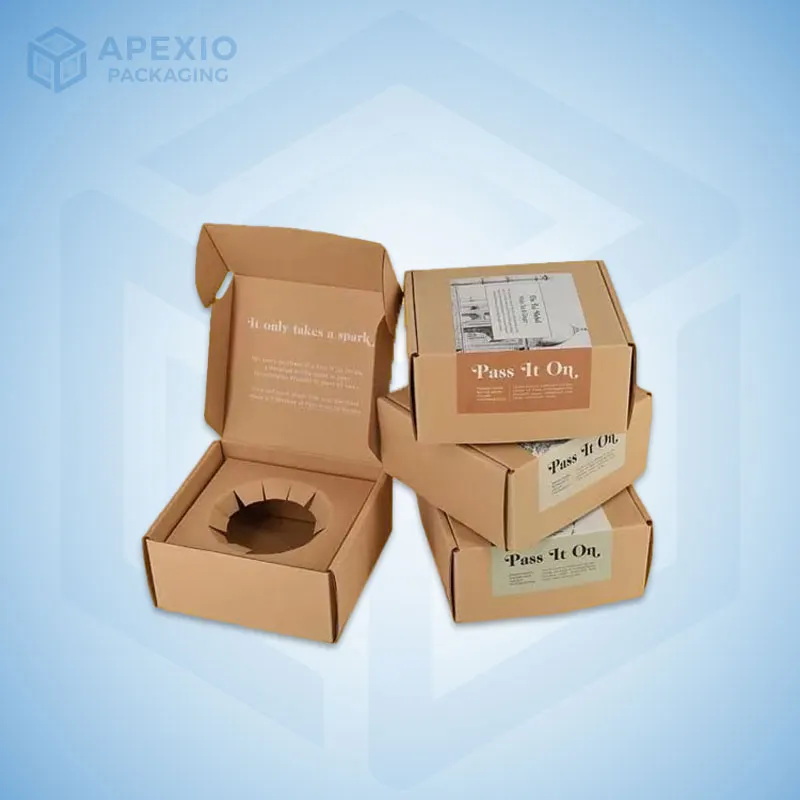
We make custom shoe boxes as printed mailer boxes, kraft mailer boxes and rigid lid boxes, built around your exact sizes. Send us the measurements of your largest shoe in each range and we’ll suggest box sizes, then share a free 3D proof before printing.
Frequently asked questions
There’s no official standard, but a typical men’s shoe box is about 13 x 7.5 x 4.5 inches, and a typical women’s shoe box is about 11 x 7 x 4 inches.
Most men’s sneaker boxes are between 13 x 9 x 5 and 14.5 x 10 x 5.5 inches. High-top sneakers and larger sizes fall on the larger end.
Ankle boot boxes are usually around 13 x 10 x 5 inches. Knee-high boot boxes are much longer, typically 19 to 23 inches long.
If you ship the shoe box inside a carton, add about 1 inch to each side. For a 14 x 10 x 5 inch shoe box, a 16 x 12 x 7 inch carton gives room for padding.
Most are made of paperboard or E-flute corrugated cardboard. Premium shoes often come in rigid boxes made from thick chipboard wrapped in printed paper.