
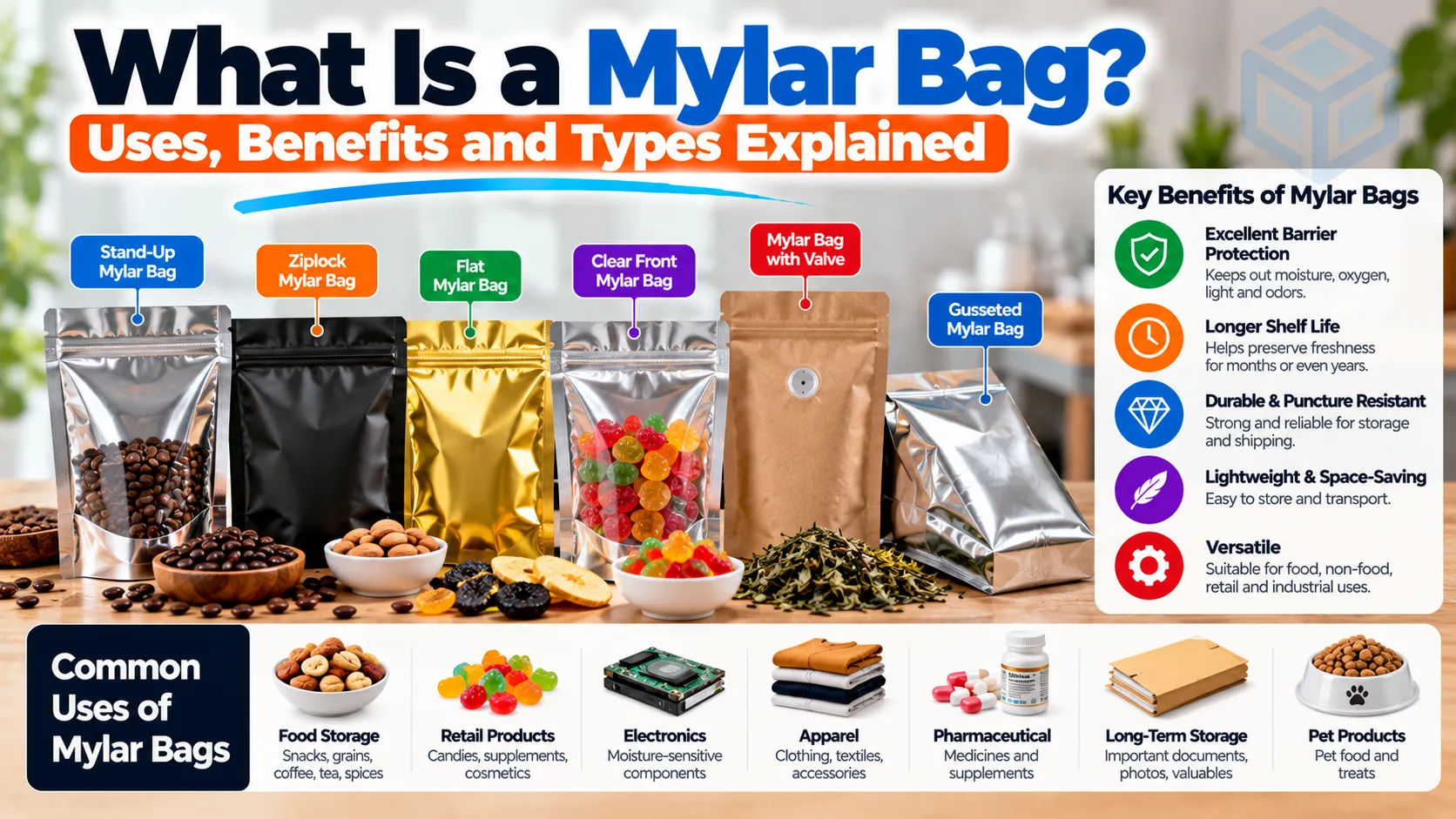
A mylar bag is a flexible pouch made from layers of polyester film (often called by the brand name Mylar), usually combined with aluminum foil or a metallized layer and a food-safe plastic lining. Those layers block light, oxygen, moisture and odors much better than ordinary plastic bags, which is why mylar bags are used for coffee, snacks, dried food, supplements, CBD and long-term food storage.
You’ve almost certainly bought something in one. That shiny stand-up pouch your coffee or trail mix came in is a mylar bag.
What is mylar made of?
Mylar is a brand name for BoPET, which stands for biaxially-oriented polyethylene terephthalate. That’s a polyester film that’s been stretched in two directions while it’s made, giving it high strength, clarity and resistance to gases.
On its own, BoPET is a thin, strong film. A mylar bag is a laminate of several layers, each with its own job:
| Layer | Material | What it does |
|---|---|---|
| Outer layer | BoPET (polyester) film, often printed | Strength, printability, scratch resistance |
| Barrier layer | Aluminum foil or metallized film | Blocks light, oxygen and moisture |
| Inner layer | Polyethylene (PE) | Food-safe contact surface and heat sealing |
The inner polyethylene layer is what melts when you heat seal the bag. If you want to know how, read our guide on how to seal mylar bags.
Benefits of mylar bags
- Strong barrier. Foil-lined mylar is one of the best flexible barriers against oxygen, moisture and light, so products stay fresh much longer.
- Odor control. Good mylar bags keep smells in and out, which matters for coffee, spices, pet treats and cannabis.
- Light weight. Much lighter than jars, tins or rigid containers, which keeps shipping costs down.
- Durable. Resistant to punctures and tears, especially in thicker gauges.
- Great for branding. The outer film prints in full color with matte, gloss, soft-touch, holographic or spot finishes.
- Flexible formats. Zippers, tear notches, windows, hang holes and valves can all be added.
Types of mylar bags
| Style | Description | Common uses |
|---|---|---|
| Stand-up pouch | Gusseted bottom so it stands on a shelf | Coffee, snacks, supplements |
| Flat pouch | Three-side seal, lies flat | Samples, tea, gummies, small portions |
| Zipper (resealable) | Press-to-close zipper below the tear notch | Snacks, CBD, pet treats |
| Child-resistant | Special zipper that’s hard for kids to open | Cannabis, edibles, pharmaceuticals |
| Window bag | Clear panel to show the product | Candy, granola, dried fruit |
| Die-cut bag | Custom outline shape | Brand-led snacks and edibles |
| Smell-proof | Thick, odor-blocking layers | Cannabis, coffee, spices |
| Holographic | Iridescent film | Cosmetics, gummies, novelty products |
| Valve bag | One-way degassing valve | Freshly roasted coffee |
Browse our custom printed mylar bags, black mylar bags, holographic mylar bags and die cut mylar bags for examples of each style.
Mylar bag thickness
Mylar bag thickness is measured in mil, where 1 mil is one thousandth of an inch (about 25 microns).
| Thickness | Feel | Best for |
|---|---|---|
| 2 to 3 mil | Thin and flexible | Retail snacks, short shelf life products |
| 3.5 to 4 mil | Standard | Coffee, tea, supplements, most retail pouches |
| 5 mil | Thick | Long-term food storage, heavier products |
| 7 mil | Very thick | Bulk storage, sharp-edged foods like pasta |
For long-term storage of dry foods like rice and beans, people usually use 5 to 7 mil bags with oxygen absorbers.
What are mylar bags used for?
- Long-term food storage of rice, beans, flour, oats and freeze-dried meals
- Coffee and tea, often with a degassing valve for coffee
- Snacks, candy, nuts and dried fruit
- Supplements, protein powder and vitamins
- Cannabis, CBD and edibles, often child-resistant and smell-proof
- Pet food and treats
- Bath salts, cosmetics samples and beauty products
- Protecting electronics, documents and seeds from moisture
If you’re selling food, see our mylar bags for food storage. For cannabis brands, our mylar weed bags and smell-proof mylar bags are the usual choice.
Mylar bags vs plastic bags
| Mylar bag | Regular plastic (PE) bag | |
|---|---|---|
| Oxygen barrier | Excellent (foil) to good (metallized) | Poor |
| Light barrier | Blocks light (foil or opaque) | Usually lets light through |
| Moisture barrier | Excellent | Moderate |
| Odor control | Strong | Weak |
| Durability | High | Moderate |
| Cost | Higher | Lower |
Plain plastic bags are fine for short-term storage. For anything that needs to stay fresh for months or years, or needs to look premium on a shelf, mylar wins easily.
Are mylar bags recyclable?
Most mylar bags are made from laminated layers of different materials, which makes them hard to recycle through regular curbside programs. Some specialist recycling schemes accept flexible packaging, and the industry is moving towards mono-material and recyclable pouches. If sustainability is a priority, ask about kraft-look and recyclable-ready options, and see our guide to what cardboard is made of for paper-based alternatives.
Custom mylar bags from Apexio
We print custom mylar bags in stand-up, flat, zipper, window and die-cut styles, with no minimum order and a free digital proof. Tell us the product, how much goes in each bag and where it’ll be sold, and we’ll suggest the right size, thickness and features. If you’ll need a barcode on the bag, our guide to barcodes and UPCs explains placement.
Frequently asked questions
A mylar bag is made of layers: a polyester (BoPET) outer film, a barrier layer of aluminum foil or metallized film, and a food-safe polyethylene inner layer.
They’re used for food storage, coffee, snacks, supplements, cannabis and CBD, pet treats and any product that needs protection from light, air and moisture.
Yes. Mylar bags designed for food have a food-safe polyethylene inner layer. Always buy from a supplier that confirms food-grade materials.
Once heat sealed, yes. A zipper on its own isn’t fully airtight, so for storage or shipping, heat seal above the zipper.
3.5 to 4 mil is standard for retail products. Use 5 to 7 mil for long-term food storage or heavier contents.