
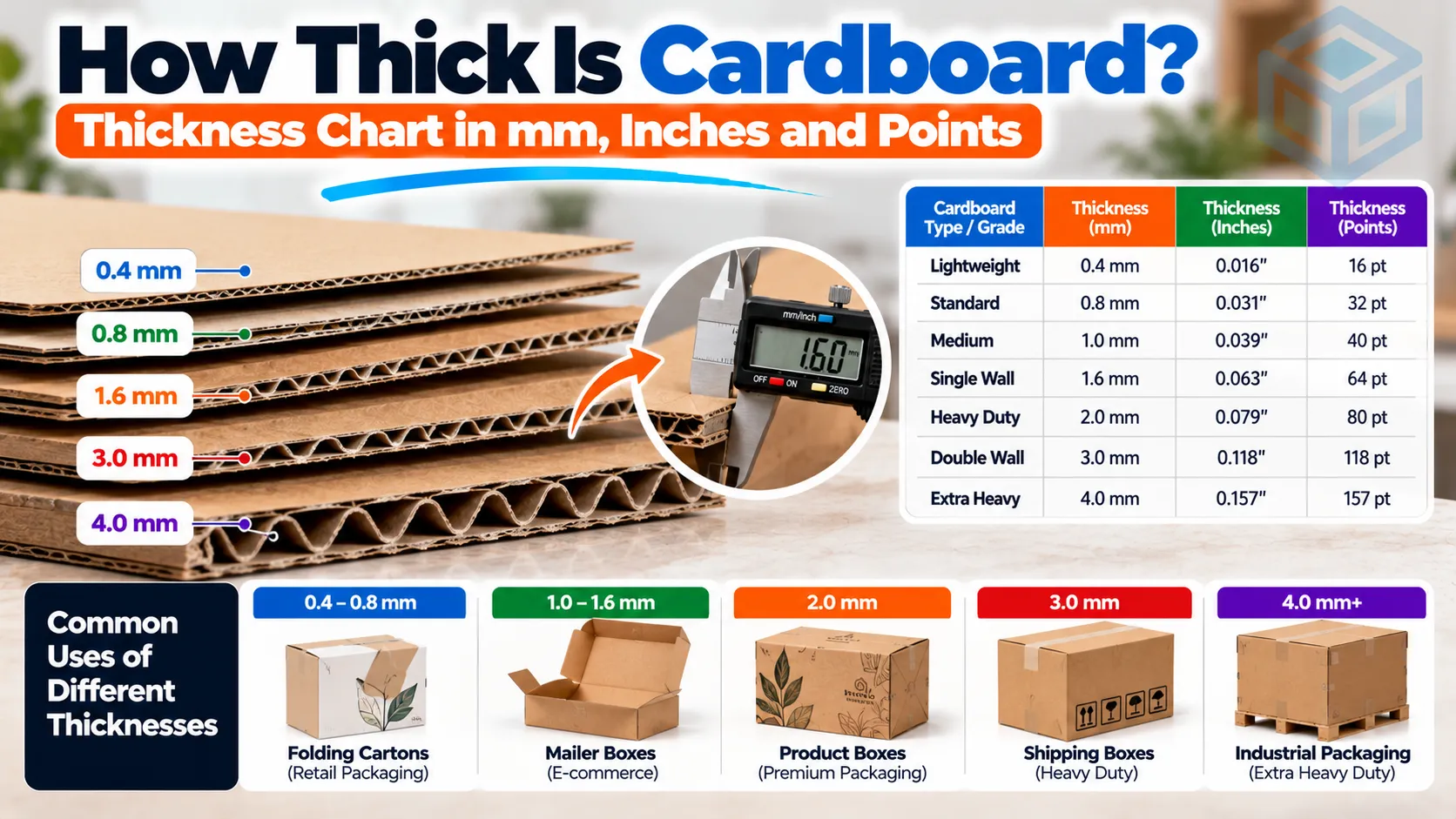
Most cardboard boxes are between about 1.5 mm and 7 mm thick. A typical single-wall shipping box is around 3 to 4 mm (about 1/8 to 5/32 inch), a double-wall box is about 6 to 7 mm (1/4 inch), and the thin card used for cereal or cosmetic boxes is only about 0.4 to 0.6 mm. So “how thick is cardboard” really depends on which kind of cardboard you mean.
Here’s a full breakdown, with a chart for each type.
Two kinds of cardboard, two ways of measuring
- Paperboard (also called boxboard or cardstock) is a single solid sheet. Its thickness is measured in points in the US, where 1 point = 0.001 inch.
- Corrugated board has a wavy fluted layer between flat liners. Its thickness depends on the flute size and how many layers it has.
If you want to know how the two are made, read what cardboard is made of.
Paperboard thickness chart
| Thickness | Millimeters | Inches | Typical use |
|---|---|---|---|
| 12 pt | 0.30 mm | 0.012 in | Sleeves, light inserts |
| 14 pt | 0.36 mm | 0.014 in | Small cosmetic and tea boxes |
| 16 pt | 0.41 mm | 0.016 in | Soap, skincare, retail cartons |
| 18 pt | 0.46 mm | 0.018 in | Standard retail boxes, cereal boxes |
| 20 pt | 0.51 mm | 0.020 in | Heavier products |
| 24 pt | 0.61 mm | 0.024 in | Premium boxes, displays |
| 28 pt | 0.71 mm | 0.028 in | Very stiff cartons |
Rigid boxes are thicker again. They use chipboard (greyboard) of about 1 to 3 mm, wrapped in printed paper. Our guide to types of rigid boxes covers them in detail.
Corrugated cardboard thickness by flute
| Flute | Approximate thickness | Fraction of an inch | Common uses |
|---|---|---|---|
| F flute | 0.8 mm | 1/32 in | Small retail and food boxes |
| E flute | 1.6 mm | 1/16 in | Mailer boxes, retail packaging |
| B flute | 3.2 mm | 1/8 in | Shipping boxes, displays |
| C flute | 4 mm | 5/32 in | Standard shipping cartons |
| A flute | 4.8 mm | 3/16 in | Cushioning for fragile items |

Single, double and triple wall thickness
| Wall type | Construction | Approximate thickness | Good for |
|---|---|---|---|
| Single wall | One fluted layer, two liners | 1.5 to 5 mm | Most e-commerce and shipping boxes |
| Double wall | Two fluted layers, three liners | 6 to 8 mm | Heavy items, stacking, moving boxes |
| Triple wall | Three fluted layers, four liners | about 12 to 15 mm | Industrial parts, bulk and export shipping |
The most common double-wall combination is BC flute (one B flute plus one C flute), which comes out at around 6.5 mm.
Is thicker cardboard always stronger?
Not exactly. Thickness helps with cushioning and stiffness, but strength also depends on the paper weights used for the liners and fluting. Two boxes of the same thickness can have very different strength ratings.
That’s why shipping boxes are rated by:
- ECT (Edge Crush Test), which measures stacking strength
- Burst strength (Mullen test), which measures how much pressure the board can take before it bursts
You’ll often find these ratings in the box maker’s certificate, a small round stamp on the bottom flap. As a general guide, a typical single-wall 32 ECT box is rated for packages up to about 40 lb, while double-wall boards are rated for 80 lb and above. Always check the stamp on the box you’re using.
How thick is a typical box?
| Box | Usual material | Approximate thickness |
|---|---|---|
| Cereal box | Recycled paperboard | 0.4 to 0.5 mm |
| Cosmetic box | 16 to 18 pt SBS | 0.4 to 0.46 mm |
| Shoe box | E flute or paperboard | 0.5 to 1.6 mm |
| Pizza box | E or B flute corrugated | 1.6 to 3.2 mm |
| Amazon-style shipping box | B or C flute single wall | 3 to 4 mm |
| Moving box (heavy duty) | Double wall | 6 to 7 mm |
For more on shoe boxes specifically, see our guide to shoe box dimensions.
Choosing the right thickness for your packaging
- Light retail products (under about 1 lb) that sit on a shelf: 16 to 18 pt paperboard.
- Products shipped directly to customers: E flute or B flute corrugated mailers.
- Heavy or fragile items: B or C flute, or double wall with inserts.
- Premium gift and luxury items: rigid chipboard boxes.
Remember that thickness affects box size too. The thicker the board, the bigger the outside dimensions compared with the inside. That matters for shipping costs, which we explain in how to measure a box for shipping.
Custom boxes in the right thickness
We make boxes in 12 to 24 pt cardstock, E and B flute corrugated, and rigid board, so you can match the thickness to your product. Popular options include custom mailer boxes and corrugated mailer boxes. Send us your product weight and size and we’ll recommend the right board.
Frequently asked questions
A standard single-wall shipping box is about 3 to 4 mm thick, which is roughly 1/8 to 5/32 inch.
Double wall cardboard is usually about 6 to 8 mm thick. The common BC flute combination is around 6.5 mm.
Corrugated board ranges from about 1/32 inch (F flute) to 3/16 inch (A flute) for single wall, and about 1/4 inch for double wall. Paperboard is much thinner, around 0.012 to 0.028 inch.
Cereal boxes are usually made of recycled paperboard about 0.4 to 0.5 mm thick, around 16 to 20 pt.
For most products, single wall B or C flute (3 to 4 mm) works well. Heavier or fragile items may need double wall.