
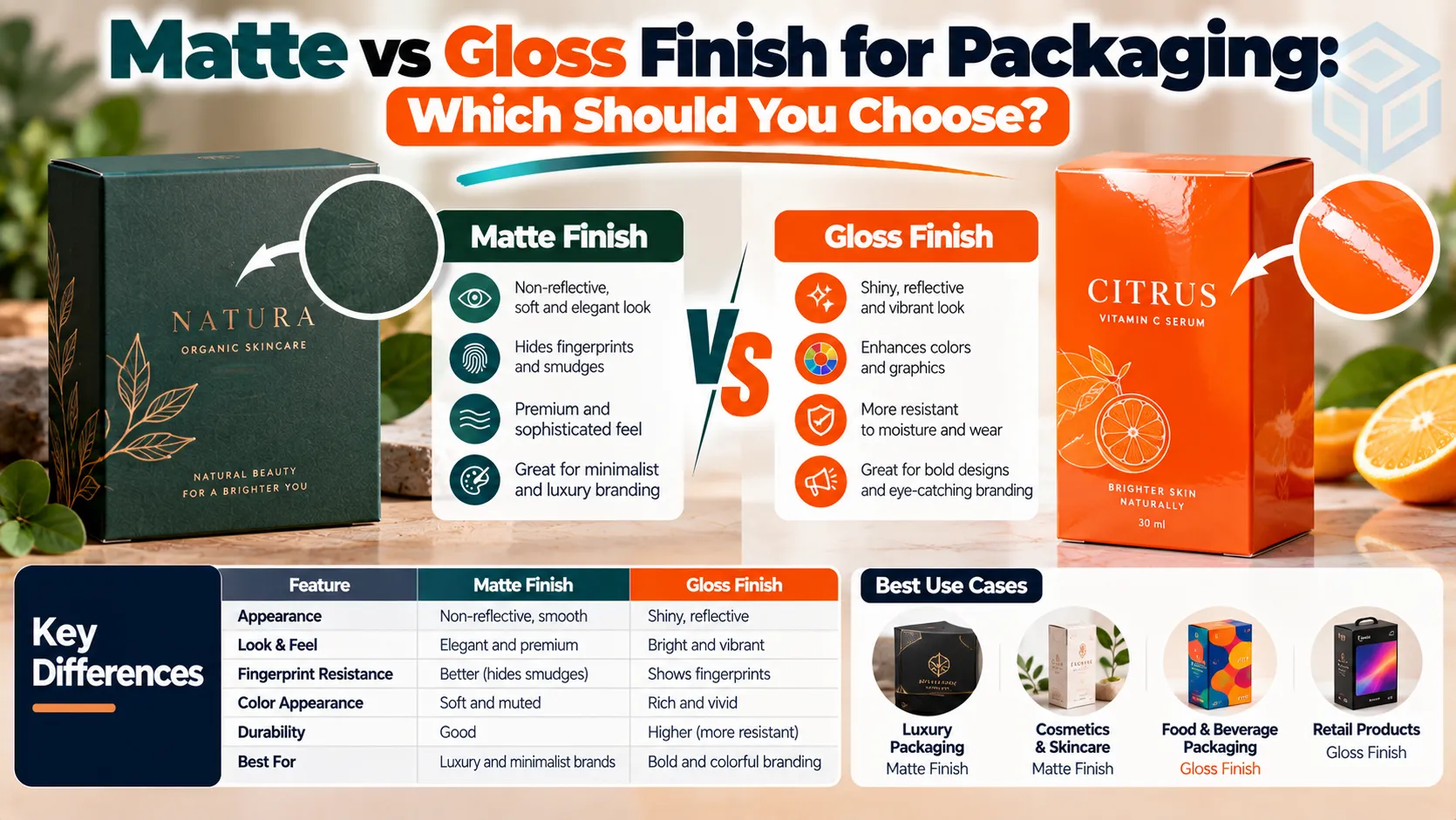
A matte finish has a smooth, flat, non-reflective surface that looks soft and modern, while a gloss finish is shiny and reflective, making colors look brighter and more saturated. Matte suits minimal, premium and natural brands; gloss suits bold, colorful and food or kids’ products. Both cost about the same, so the choice is mostly about the look you want and how the packaging will be handled.
There’s a bit more to it than shiny vs not shiny, though, so here’s a full comparison.
Matte vs gloss at a glance
| Matte finish | Gloss finish | |
|---|---|---|
| Look | Flat, soft, no shine | Shiny, reflective |
| Colors | Slightly muted and sophisticated | Bright, vivid and saturated |
| Glare under lights | None | Can reflect store lighting |
| Feel | Smooth, sometimes velvety | Slick and smooth |
| Fingerprints and scuffs | Can show scuffs, especially on dark colors | Wipes clean easily |
| Readability | Excellent from any angle | Text can be hard to read in glare |
| Brand feel | Premium, modern, natural, minimal | Energetic, bold, playful |
| Cost | About the same | About the same |
Lamination vs coating
Matte and gloss finishes are applied in two main ways:
- Lamination: a thin plastic film (usually BOPP) is bonded over the printed sheet. It adds strength, moisture resistance and scuff protection. This is the most common option for boxes.
- Coating: a liquid layer such as aqueous coating or UV varnish is applied on press and dried. It’s thinner and cheaper than a laminate and easier to recycle, but offers less protection.
Both come in matte and gloss versions. For boxes that get handled a lot, lamination is usually worth it.
When to choose a matte finish
Matte works best when you want the packaging to feel calm, refined or natural. It’s a favorite for:
- Skincare, cosmetics and wellness products
- Luxury and minimalist brands
- Candles, tea, coffee and artisan foods
- Boxes with lots of text, because there’s no glare
One thing to watch: matte black and very dark matte colors show scuffs and fingerprints more easily. If your box is dark, ask for an anti-scratch matte or soft-touch film.
When to choose a gloss finish
Gloss makes colors jump off the shelf. It’s a great fit for:
- Snacks, candy and food packaging with photos
- Kids’ products and toys
- Bright, colorful brands
- Products that need to stand out in busy retail aisles
Gloss also resists wear well and wipes clean easily, which helps on food packaging that gets handled a lot.

What about soft-touch?
Soft-touch is a special matte laminate with a velvety, almost suede-like feel. It’s one of the most popular finishes for premium boxes because people notice it the moment they pick the box up. It costs a little more than regular matte, and like other matte finishes it can mark more easily on dark designs, so anti-scratch soft-touch films are worth asking about.
Combining matte and gloss
You don’t have to pick just one. Some of the most striking packaging uses both:
- Matte with spot UV: the whole box is matte, and selected areas (like the logo) get a glossy, raised UV coating. The contrast between shiny and flat catches the light beautifully.
- Matte with foil: gold or silver foil looks especially rich against a matte background.
- Matte with embossing: raised or pressed designs show up clearly on a flat surface. See embossing vs debossing.
Matte vs gloss for stickers and labels
Stickers follow the same logic. Matte stickers look modern and are easy to read and write on, which makes them great for product labels. Gloss stickers look vibrant and are ideal for promotional and kids’ stickers. Laminated vinyl stickers in either finish are waterproof. Our custom matte stickers are a popular choice for brand labels, and our circle sticker sizes guide helps with sizing.
Matte vs gloss and barcodes
If your packaging has a barcode, a matte finish is the safer choice around it. Gloss can reflect scanner light and cause read errors. Our guide to barcodes and UPCs on product labels covers this.
Does the finish affect recycling?
Plastic laminates (both matte and gloss) make paperboard a little harder to recycle, although many recycling mills can still process laminated board. If recyclability is a priority, ask about aqueous coatings, which give a matte or gloss effect without a plastic film.
How to decide
- Think about your brand. Calm and premium leans matte; bold and colorful leans gloss.
- Think about the product photos. Food and product photography usually looks better in gloss.
- Think about handling. Dark matte boxes need anti-scratch film; gloss wipes clean.
- Think about where it’s sold. Under bright retail lights, gloss can glare.
- Ask for both on your proof. Seeing them side by side usually settles it.
Finishes at Apexio
Every box, bag and sticker we print can be finished in gloss, matte or anti-scratch soft-touch, with options for spot UV, foil and embossing. Whether it’s custom cosmetic boxes or custom mailer boxes, we’ll show the finish on your free 3D proof before printing. If you’re also deciding how to print, read offset vs digital printing.
Frequently asked questions
Neither is better overall. Matte looks premium and modern with no glare; gloss makes colors brighter and wipes clean easily. The right choice depends on your brand and product.
They cost about the same. Specialty finishes like soft-touch or spot UV cost a little more.
Standard matte can show scuffs, especially on dark colors. Anti-scratch matte or soft-touch films reduce this.
Gloss usually makes photos look sharper and more vivid. Matte gives a softer, more artistic look.
Yes. A matte box with spot UV gloss on the logo or key details is one of the most popular premium combinations.