
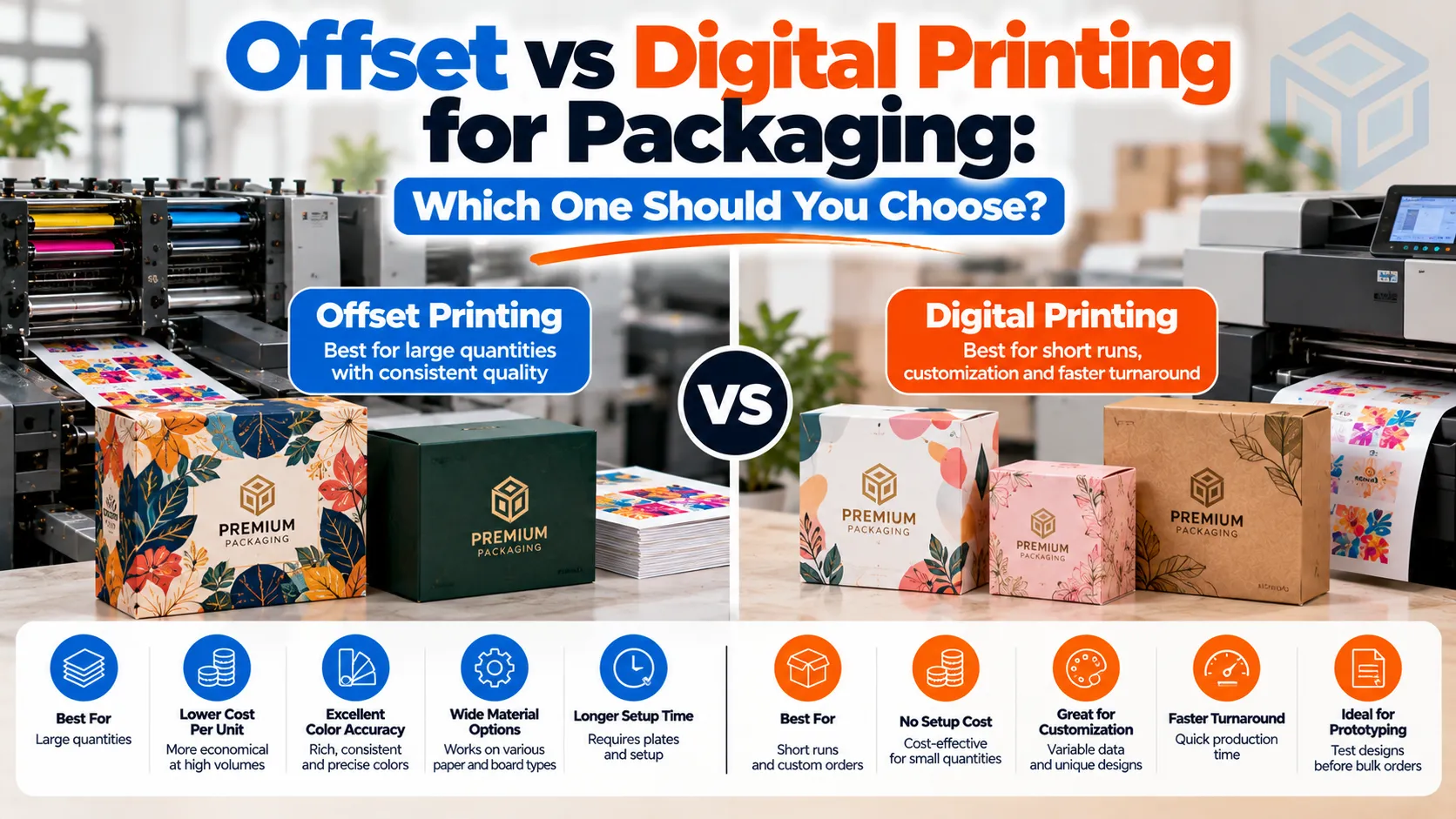
Offset printing transfers ink from metal plates onto a rubber blanket and then onto the sheet, while digital printing puts the image straight onto the material from a file, with no plates. Offset costs more to set up but becomes cheaper per unit on large runs and gives the most accurate color, especially Pantone matches. Digital has almost no setup cost, so it’s the better choice for short runs, samples and products with many designs.
For packaging, the right choice usually comes down to one question: how many do you need?
Offset vs digital at a glance
| Offset printing | Digital printing | |
|---|---|---|
| How it works | Plates, rubber blanket, wet ink | Direct from file, toner or inkjet |
| Setup | Plates and press setup for each design | Little to none |
| Best quantity | Larger runs, often 1,000+ units | Short runs, from 1 to a few hundred or more |
| Cost per unit | Drops sharply as quantity rises | Stays fairly flat |
| Color accuracy | Excellent, true Pantone spot colors | Very good CMYK, Pantone simulated |
| Turnaround | Longer, because of setup | Faster |
| Variable data | No | Yes (names, numbers, versions) |
| Materials | Very wide range of papers and boards | Wide, with some limits on thick or textured stocks |
How offset printing works
Offset lithography relies on a simple fact: oil and water don’t mix. The artwork is burned onto aluminum plates, one plate per color. On the press, the plates are dampened with water and inked, and the ink sticks only to the image areas. The plate transfers (or “offsets”) the inked image onto a rubber blanket, and the blanket presses it onto the sheet.
A standard full-color job uses four plates, one each for cyan, magenta, yellow and black (CMYK). Extra plates can be added for Pantone spot colors, metallic inks or a coating.
Because each design needs its own plates and the press has to be set up and color-matched, offset has a real setup cost. Once it’s running, though, it’s extremely fast and consistent, so the cost per box falls quickly as the quantity goes up.
How digital printing works
Digital presses work more like a very advanced office printer. The image is sent straight from the file to the press, which prints it with toner or inkjet ink. There are no plates and very little setup, so the first box costs about the same as the hundredth.
That makes digital printing ideal when you need:
- a small quantity, from a handful of samples to a few hundred boxes
- many different designs, flavors or SKUs, each in small numbers
- personalized packaging with names, numbers or unique codes
- a quick turnaround for a launch, event or test
Cost: where the break-even point sits
The exact numbers depend on the box size, the stock and the number of colors, but the pattern is always the same.
| Quantity | Usually cheaper | Why |
|---|---|---|
| 1 to 250 | Digital | No plates or press setup |
| 250 to 1,000 | Depends on the job | Box size, colors and finishes decide |
| 1,000 to 5,000 | Usually offset | Setup cost is spread over more units |
| 5,000+ | Offset | Lowest cost per unit by far |
If you’re on the fence, ask for quotes at two or three quantities. You’ll often find that the price per box drops so much with offset that ordering a few more makes sense.
Color accuracy and Pantone
Offset is still the standard for exact brand colors. It can print true Pantone (PMS) spot colors using pre-mixed ink, so your brand color looks the same on every reprint.
Digital presses print in CMYK (and some use extended color sets) and simulate Pantone colors. Modern digital color is excellent and matches most colors closely, but a few bright oranges, greens, blues and metallics are hard to reproduce exactly. If your brand relies on one specific color, offset or a test print is the safe route. Our color guide explains CMYK, Pantone and RGB.
Finishes and materials
Both methods work with the finishes that make packaging feel premium, like matte and gloss lamination, soft-touch, foil, spot UV and embossing. These are usually added after printing, so the choice of print method doesn’t limit them much.
Offset handles a wider range of papers and boards, including heavy and textured stocks. For corrugated boxes, packaging is often printed with flexography (a third method using flexible plates) or printed offset on paper that’s then laminated to corrugated board, called litho-lam. For thin or uncommon materials, check with your printer.
Which should you choose?
Choose digital if:
- you need fewer than a few hundred units
- you’re testing a new product or design
- you have many versions in small quantities
- you need it fast
Choose offset if:
- you need 1,000 or more of the same design
- exact Pantone color matters
- you’re reordering regularly and want the lowest unit price
- you’re using specialty paper stocks
Many brands use both: digital for samples and the first small batch, then offset once a design is proven and the volume grows.
How we print at Apexio
We print custom boxes, custom printed bags and stickers both ways and recommend the method based on your quantity and artwork. With no minimum order, you can start small on digital and move to offset as you scale. If you’re also choosing a board, see our guide to what GSM means for paper.
Frequently asked questions
Offset uses plates and a rubber blanket to transfer ink to paper, while digital prints directly from a file without plates. Offset is cheaper for large runs and best for exact colors; digital is cheaper and faster for small runs.
Offset gives the most consistent color and true Pantone matching, so it’s often considered the highest quality. Modern digital printing is very close, and most customers can’t tell the difference on everyday packaging.
Digital is cheaper for small quantities. Offset is cheaper per unit once you reach larger quantities, often around 1,000 units or more, because the setup cost is spread out.
Offset lithography is the full name for offset printing. It uses the principle that oil and water repel each other to transfer an inked image from a plate to a rubber blanket and then to the paper.
It can get close for most colors by simulating them with CMYK or extended inks, but some colors, especially very bright or metallic ones, are matched more accurately with offset.