
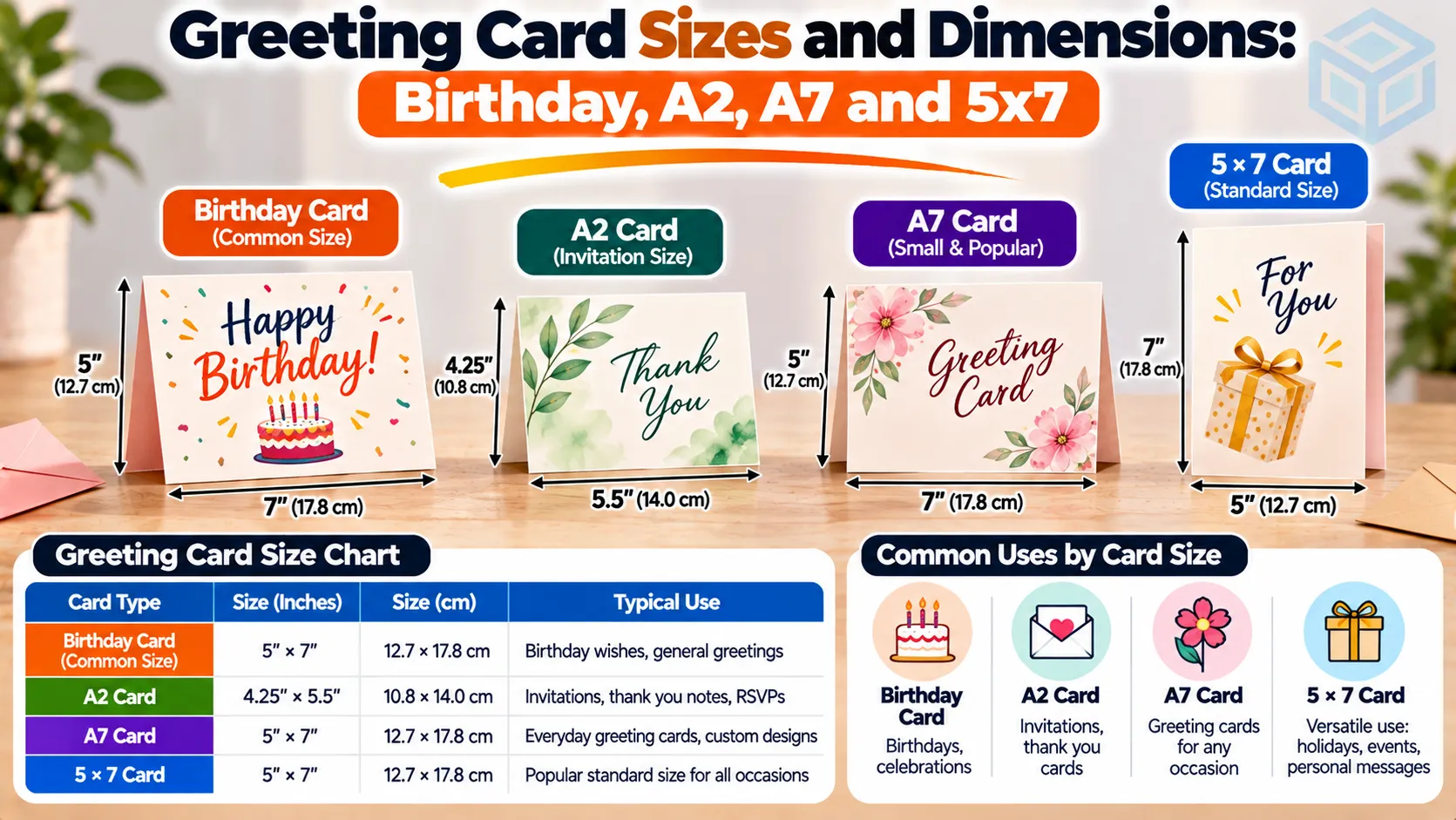
The most common greeting card size is 5 x 7 inches (called A7), and it’s the usual size for birthday cards and invitations. The other popular sizes are A2 at 4 1/4 x 5 1/2 inches, A6 at 4 1/2 x 6 1/4 inches and A9 at 5 1/2 x 8 1/2 inches. Each one has a matching envelope that’s about 1/4 inch larger.
Here’s the full chart, plus tips on paper weight, folding and postage.
Greeting card size chart
| Card name | Folded size (inches) | Folded size (mm) | Flat size before folding | Envelope |
|---|---|---|---|---|
| A1 | 3 1/2 x 4 7/8 | 89 x 124 | 7 x 4 7/8 | A1 (3 5/8 x 5 1/8) |
| A2 | 4 1/4 x 5 1/2 | 108 x 140 | 8 1/2 x 5 1/2 | A2 (4 3/8 x 5 3/4) |
| A6 | 4 1/2 x 6 1/4 | 114 x 159 | 9 x 6 1/4 | A6 (4 3/4 x 6 1/2) |
| A7 | 5 x 7 | 127 x 178 | 10 x 7 | A7 (5 1/4 x 7 1/4) |
| A9 | 5 1/2 x 8 1/2 | 140 x 216 | 11 x 8 1/2 | A9 (5 3/4 x 8 3/4) |
| Square | 5 1/2 x 5 1/2 or 6 x 6 | 140 or 152 square | Varies | Square, 1/4 in larger |
The A2 card is popular because two of them fit on a standard letter-size sheet (8 1/2 x 11 inches) when printed flat and folded in half.
What size is a birthday card?
Most store-bought birthday cards are 5 x 7 inches (A7). Smaller birthday notes and thank-you cards are usually A2 (4 1/4 x 5 1/2 inches). Kids’ cards and premium cards are sometimes square, and novelty cards can be much larger.
Folded vs flat cards
- Folded cards are printed on a sheet twice the size and folded in half. Fold along the short side for a portrait card, or along the long side for a landscape (tent) card.
- Flat cards are a single panel, printed on one or both sides. They’re common for invitations, thank-you cards and postcards.
Best paper weight for greeting cards
Greeting cards are printed on cardstock so they stand up on a shelf and feel solid in the hand.
| Use | Weight | Approx. GSM |
|---|---|---|
| Lightweight cards, inserts | 65 to 80 lb cover | 176 to 216 GSM |
| Standard greeting cards | 80 to 100 lb cover | 216 to 270 GSM |
| Premium and invitations | 110 to 130 lb cover | 300 to 350 GSM |
Always score the fold on heavier cardstock so the fiber doesn’t crack. Our guides to what cardstock is and what GSM means go deeper.
Postage and size: what to watch
- Square cards usually cost more to mail in the US, because sorting machines can’t handle them. Rectangular cards are cheaper.
- Postcard rates in the US apply only to cards between 3 1/2 x 5 and 4 1/4 x 6 inches and within a set thickness. Larger flat cards pay letter postage.
- Embellishments like ribbons, buttons or thick layers can push a card into a higher postage category.
- Check current USPS rules for any large or unusual mailing.
For envelope sizes in full, see our standard envelope sizes chart.
Packaging greeting cards for sale or gifting
If you sell cards, packaging matters as much as the card:
- Clear sleeves protect single cards on a retail rack.
- Card boxes hold boxed sets of 6, 8 or 10 cards with envelopes.
- Gift boxes pair a card with a small present, a common choice for birthdays and corporate gifts.
- Sticker seals close the envelope and add branding. Our circle sticker sizes guide helps you choose one.
We make custom gift boxes and birthday gift boxes that can be sized to fit a card on top of the gift, plus birthday stickers for envelope seals.
Frequently asked questions
5 x 7 inches (A7) is the most common size. A2 (4 1/4 x 5 1/2 inches) is the most common smaller size.
An A2 card is 4 1/4 x 5 1/2 inches when folded, and 8 1/2 x 5 1/2 inches flat.
An A7 envelope, which is 5 1/4 x 7 1/4 inches.
Most birthday cards are 5 x 7 inches. Smaller birthday notes are often A2 size.
In the US, usually yes. Square envelopes can’t go through automated sorting, so they carry an extra charge.